
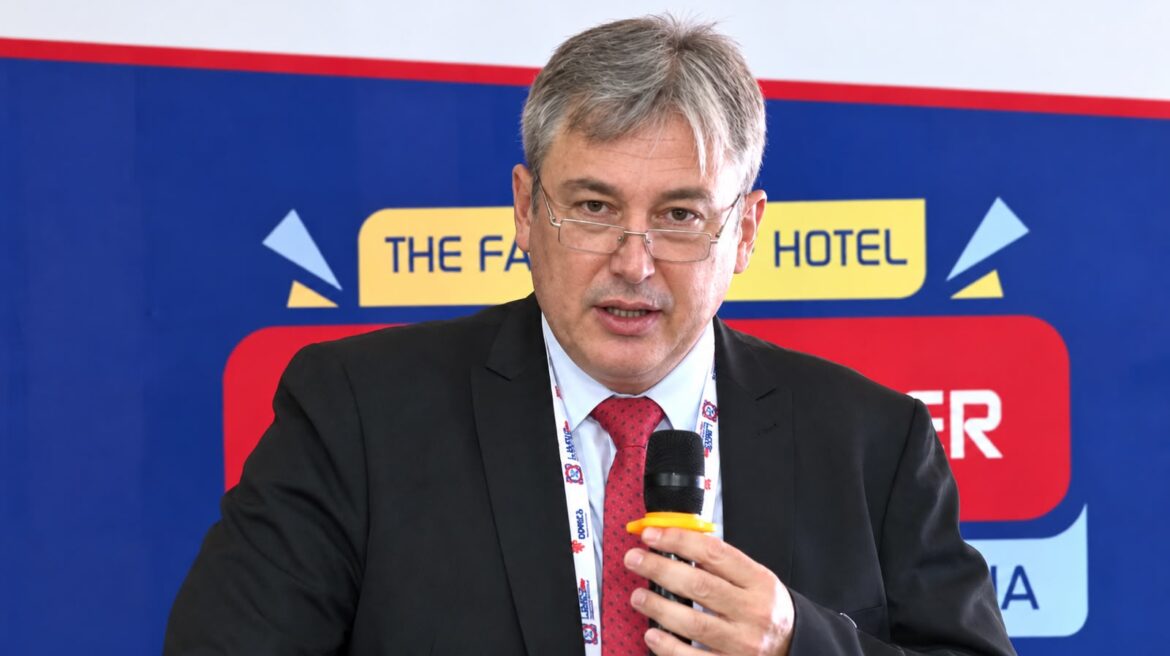
At Liberia’s international mining and energy conference, Chief Executive Michiel van der Merwe outlined plans for higher iron ore exports, shared railway access and a partnership intended to last decades.
MARGIBI COUNTY, Liberia — ArcelorMittal Liberia expects to export more than 20 million tons of iron ore in 2027, up from under five million tons in 2024, its chief executive said Wednesday, outlining an expansion that could substantially increase Liberia’s mineral exports and strengthen the infrastructure supporting its mining economy.
Speaking at the Liberia International Mining and Energy Conference and Expo, where the company is a platinum sponsor, Michiel van der Merwe said ArcelorMittal’s investment in Liberia was approaching $4 billion. That commitment, he said, extends across mines, railway operations, port facilities, power and social infrastructure.
His address presented the company’s next phase as both an industrial expansion and a test of what sustained cooperation between government and investors can deliver: higher-value mineral production, greater opportunities for Liberian workers and infrastructure capable of supporting additional mining companies.
“It is an investment in jobs, skills and local businesses,” he said. “Most importantly, it is an investment in Liberia’s future.”
The two-day conference, taking place October 28–29 at the Farmington Hotel, brings government officials, investors and industry leaders together to discuss the future of Liberia’s mining and energy sectors. For ArcelorMittal Liberia, it offered a platform to explain how two decades of investment could support a much larger operation in the years ahead.
Van der Merwe began with a simple numerical refrain: “One, Two, Three and Four.”
One company, he said, had reopened Liberia’s iron ore mining sector in 2011. Its commitment had continued for two decades, across three presidential administrations, with investment now approaching $4 billion.
The sequence framed a central argument of his speech: major industrial projects depend on relationships and commitments that endure beyond any single political administration.
Today, the company connects iron ore deposits in Nimba County with Buchanan Port through a railway that van der Merwe described as 245 kilometres long. Thousands of Liberians, he said, help operate that integrated system.
Its next stage of growth rests on the Phase II expansion and the commissioning of Liberia’s first large-scale iron ore concentrator, which he described as a milestone for both the company and the country.
The concentrator allows ArcelorMittal Liberia to process ore into a higher-value product for international steelmakers. Van der Merwe said that premium concentrate would serve existing steel mills as well as a new generation using technologies designed to reduce carbon emissions.
For Liberia, the significance reaches beyond the amount of ore leaving the country. Processing more of that material before export represents a step toward capturing greater value from its mineral resources and developing the technical capabilities required to sustain a more sophisticated mining industry.
Van der Merwe said the project also demonstrated Liberia’s ability to attract and carry out large-scale industrial investments that create employment, build local capacity and strengthen national infrastructure.
The production ambitions are substantial. After exports of under five million tons in 2024, the company expects to ship more than 20 million tons in 2027, he said. It is also planning for eventual growth to 30 million tons at the mines.
Those figures remain company projections. But they illustrate the scale of the transformation ArcelorMittal Liberia is seeking — and the importance of the railway and port facilities needed to move that production to market.
Van der Merwe said the company had invested $800 million to rehabilitate and expand the government-owned railway and port infrastructure. Its current railway expansion, he added, already supports the company’s planned future growth, allowing other operators to use surplus capacity temporarily.
The distinction between public ownership and private investment was a prominent part of his remarks. The assets belong to the Government of Liberia, he said, while ArcelorMittal has financed the rehabilitation and expansion needed to support its operations.
He also reaffirmed the company’s support for a railway serving multiple users.
“ArcelorMittal is fully committed to the desire of the three Presidential administrations that this Tokadeh to Buchanan Railway is a multiuser asset available for other companies to use,” he said.
According to van der Merwe, the Third Amendment to the company’s Mineral Development Agreement, ratified earlier this year, provides for access by other users, with the Liberian government deciding which additional companies may use the infrastructure.
He said prospective users would need to finance their own expansion requirements, building on the foundational investments ArcelorMittal has already made.
That approach places the company’s infrastructure spending within a broader development argument: an established railway and port system can provide a starting point for additional projects, extending the economic reach of investments originally made to support one mining operation.
Van der Merwe said operating arrangements discussed across three administrations over the past decade were now being formalized through the Rail Systems Operating Principles, known as the RSOP. Those principles, he said, include an independent company operating the railway beginning in 2030.
“The establishment of an independent rail operator marks a significant step in Liberia’s economic transformation,” he said.
He described the arrangement as a foundation for shared infrastructure that could open new mining opportunities, attract investment and accelerate national development.
He also expressed support for the government’s proposed creation of a National Rail Authority to oversee the development of additional railway corridors. ArcelorMittal, he said, wants the agreed operating principles for the Tokadeh–Buchanan railway recognized when that institution is established.
Beyond infrastructure, van der Merwe emphasized the importance of developing Liberian expertise.
The country’s mineral wealth, location and investment ambitions provide a basis for growth, he said. Turning those advantages into lasting prosperity requires collaboration among government, companies, investors and communities, alongside a sustained commitment to training Liberians.
That investment in people, he argued, would help ensure that future generations can lead and sustain the industries now being built.
His remarks linked the company’s expansion to a wider international opportunity. As economies develop and pursue lower-carbon technologies, he said, countries with strong resources, stable investment conditions and durable partnerships will be better positioned to compete.
For ArcelorMittal Liberia, the message was one of continued commitment: the concentrator, expanded logistics infrastructure and planned production increases form part of a relationship that the company expects to carry well into the future.
“No single company, government institution or investor can achieve all of Liberia’s goals alone,” van der Merwe said. “But together, we can create an environment where investment thrives, industries grow and communities prosper.”
He closed by returning to the time horizon behind the company’s investment.
“We’ve played this part for the last twenty years,” he said, “and we are ready to do so for another forty years or more.”
See more Liberia News Network stories in Google Search by adding LNN as one of your Preferred Sources.
★ Add LNN as a Preferred Source