
Published: November 4, 2026
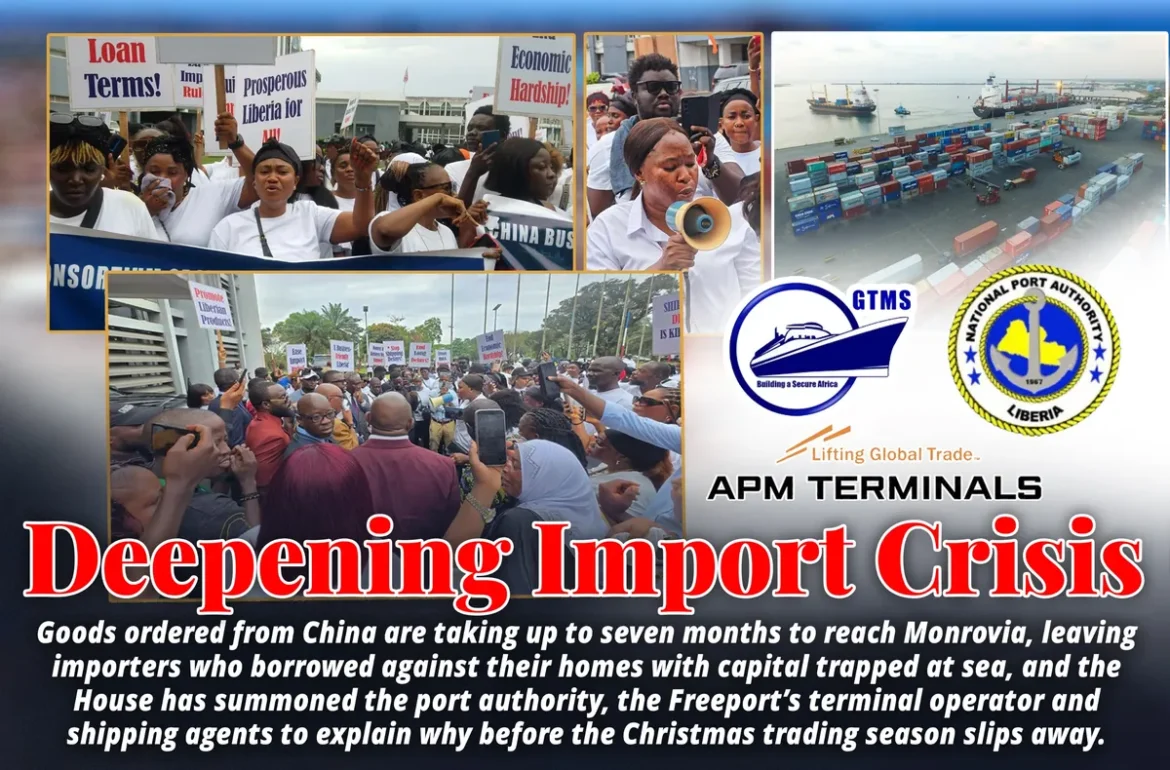
CAPITOL HILL, Monrovia — Goods ordered from China are taking as long as seven months to reach Monrovia, Liberian importers told the House of Representatives on Tuesday, and lawmakers have summoned the port authority, the Freeport’s terminal operator and shipping agents to an emergency meeting Friday to explain why, with the Christmas trading season weeks away.
The businesswomen behind the complaint say the delays have trapped capital many of them borrowed against their homes, while loan interest, quarterly taxes, rent and salaries keep falling due on goods they cannot sell.
“Our businesses are collapsing, our investments are trapped, and our families are suffering,” the China Business Women United With One Voice/Consortium of Liberia Importers wrote in a petition dated Nov. 3 and addressed to both houses of the Legislature and the National Port Authority’s management.
The House agreed to convene the meeting at noon Friday in the Speaker’s conference room. Invited are the Ministry of Commerce and Industry, the Liberia Chamber of Commerce, MEDTECH, the Association of Shipping Agencies in Liberia, the National Port Authority, APM Terminals, the National Customs Brokers Association, the Liberia Maritime Authority, the China Business Association, Global Tracking and Maritime Solutions, the Liberia Business Association and representatives of the petitioners. Relevant House committees will also attend so the information gathered can feed their ongoing work on maritime matters.
The petition singles out Maersk Line, blaming it for excessive transit times, arbitrary handling fees and cargo delays, and asks the Legislature to open an immediate inquiry into the company and other shipping lines. Maersk is not among the institutions invited to Friday’s meeting.
The petitioners say the delays make ordinary business impossible. Shipments from China and Asia now take six to seven months to arrive, they wrote, which prevents Liberian importers from turning over their capital even twice a year. Many finance their stock with high-interest bank loans secured by their homes and other property.
Because cargo is held up at sea and at port clearance, the petition says, Delivery Orders often expire before importers can collect their containers, forcing them to pay renewal fees, administrative surcharges, and demurrage and detention charges for delays they did not cause. Meanwhile, quarterly tax obligations to the Liberia Revenue Authority, office rent and staff salaries continue.
Rep. Michael Thomas called the matter urgent and pressed for emergency engagement, noting that Christmas is the peak trading season. Lawmakers warned that importers who receive merchandise after the holidays will be left with capital tied up and fewer chances to sell.
During Tuesday’s debate, a lawmaker said the APM Terminals concession area at the Freeport is already heavily occupied and that more capacity may be needed. Members also cited reports of shipments dating to April that arrived only months later. Lawmakers stressed that the petition concerns the timely arrival and clearance of goods, not freight prices.
The House action follows a similar move in the Senate. In a letter to Senate President Pro Tempore Nyonblee Karnga-Lawrence, reported by The Liberian Investigator last week, Gbarpolu County Sen. Amara M. Konneh asked that the National Port Authority, APM Terminals, MEDTECH, Global Tracking and Maritime Solutions, the Customs Department of the Liberia Revenue Authority, the Ministry of Commerce and Industry and the customs brokers’ association appear before the full Senate, sitting as a Committee of the Whole, to explain the delays.
Konneh’s letter said importers and shipping agents report that containers bound for Liberia spend more than 30 days at sea before berthing at the Freeport, with most vessels routed to and queued at ports in Ivory Coast and Ghana. He attributed the backlog to two alleged constraints at the Freeport: a lack of yard space for additional containers, and the inability of larger vessels to berth because dredging of the port basin and channel has been repeatedly delayed.
“These delays are severely hurting business inventories, tying up working capital, leading to stock-outs, and imposing heavy demurrage costs,” Konneh wrote.
Konneh, a former finance minister, also said importers face opaque fees charged by APM Terminals, MEDTECH, GTMS and others in the supply chain, costs that are passed on to consumers. He argued that port inefficiencies help explain why consumer prices remain high even as headline inflation has fallen to 4.6% and the Liberian dollar has strengthened.
The businesswomen’s petition asks the government to require shipping lines and port authorities to waive reissuance fees and demurrage on expired Delivery Orders when delays are caused by shipping schedules or port congestion. It also seeks binding arrival and cargo-handover timelines for shipping operators, faster container clearance at the Freeport, and long-term maritime and supply-chain reforms to prevent recurring backlogs.
The petitioners also want strict enforcement of the policy meant to protect Liberian-owned small and medium-sized businesses from foreign competition in retail and wholesale trade. They complain that foreign traders import directly from Chinese factories and sell at retail in Liberia at undercut prices, driving local entrepreneurs out of business.
“We are not enemies of the state; we are the backbone of Liberia’s economy. We want to work, pay our taxes, and employ our people, but we cannot survive a broken shipping and port system,” the petition says.
See more Liberia News Network stories in Google Search by adding LNN as one of your Preferred Sources.
★ Add LNN as a Preferred Source