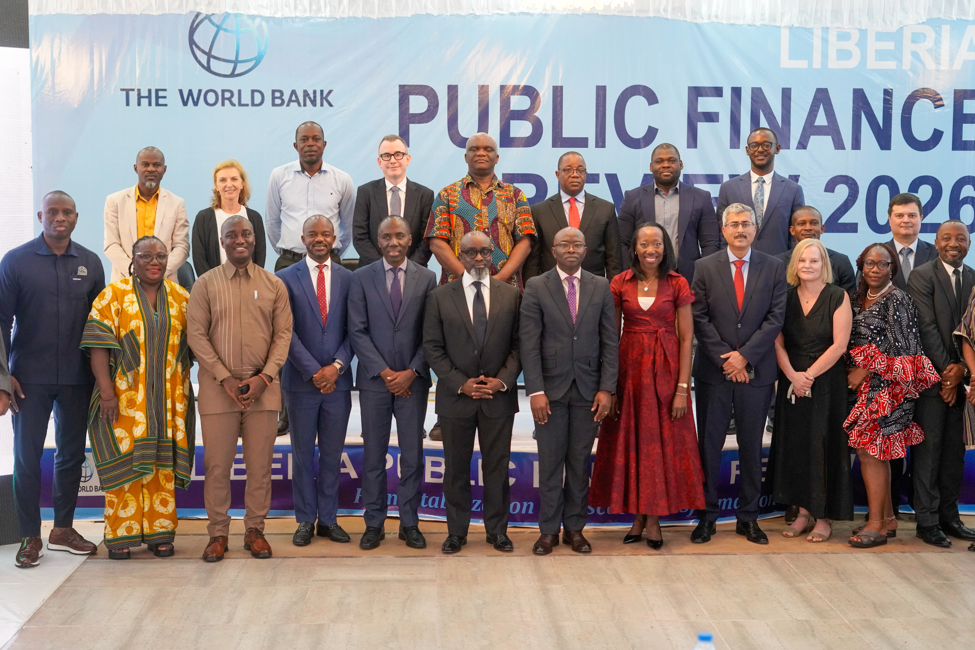
MONROVIA — The World Bank Group has commended the Liberian government for restoring macroeconomic and fiscal stability, while outlining a strategic roadmap to transition the nation from basic fiscal stabilization toward comprehensive fiscal transformation.
Speaking in Monrovia at the official launch of the Liberia Public Finance Review (PFR) 2026: From Stabilization to Fiscal Transformation, World Bank Country Manager Georgia Wallen highlighted the country’s recent progress, noting that economic growth has strengthened, fiscal deficits have narrowed, and the public debt burden has declined.
Wallen emphasized that these stabilization achievements serve as a solid foundation to address the financial demands of Liberia’s national development goals, particularly the ARREST Agenda for Inclusive Development (AAID), which requires an estimated $8.4 billion over five years to address infrastructure, human capital, and economic governance priorities ahead of Vision 2030.
To generate the durable fiscal space required for these ambitions, the Public Finance Review identifies four key strategic opportunities:
Maximizing Domestic Revenue Collection
Liberia possesses significant scope to collect additional revenue within its existing tax framework. With an estimated tax gap of approximately 3 percent of GDP, Wallen noted that the government can mobilize substantial additional resources by strengthening compliance and enforcement, leveraging digital technologies, and rationalizing tax expenditures without relying primarily on higher statutory tax rates. Ongoing initiatives—such as the transition to a Value Added Tax (VAT) and the expansion of the Integrated Tax Administration System (ITAS)—provide a strong foundation for these efforts.
Capitalizing on Natural Resource Wealth
Mining revenues in Liberia have expanded fivefold over the past decade, rising from $27 million in 2016 to $141 million in 2025. The PFR notes that the sector’s fiscal contributions can be expanded further through improved information sharing, stronger revenue administration, enhanced audit capacity, and closer inter-institutional coordination.
Improving Expenditure Quality and Efficiency
Following recent fiscal adjustments, the World Bank recommends shifting focus toward the efficiency of public spending. Strengthening project preparation, procurement processes, payroll management, and the integration of domestic and external capital investments will ensure that public funds deliver maximum development impact in infrastructure and essential services.
Mitigating Fiscal Risks and Protecting Gains
To safeguard macroeconomic stability against future external shocks, the report calls for enhanced oversight of State-Owned Enterprises (SOEs), prudent debt management, and the integration of climate and commodity price risks into long-term fiscal planning.
According to World Bank projections, the sustained implementation of these targeted reforms could yield annual fiscal gains equivalent to 3.9 to 5.3 percent of GDP by 2030, creating significant financial capacity to fund roads, healthcare, education, and energy grid expansion.
Reaffirming the institution’s commitment, Wallen stated that the World Bank stands ready to partner with the Liberian government, private sector stakeholders, and international development partners to translate the review’s policy recommendations into measurable development outcomes for the Liberian people.
See more Liberia News Network stories in Google Search by adding LNN as one of your Preferred Sources.
★ Add LNN as a Preferred Source