
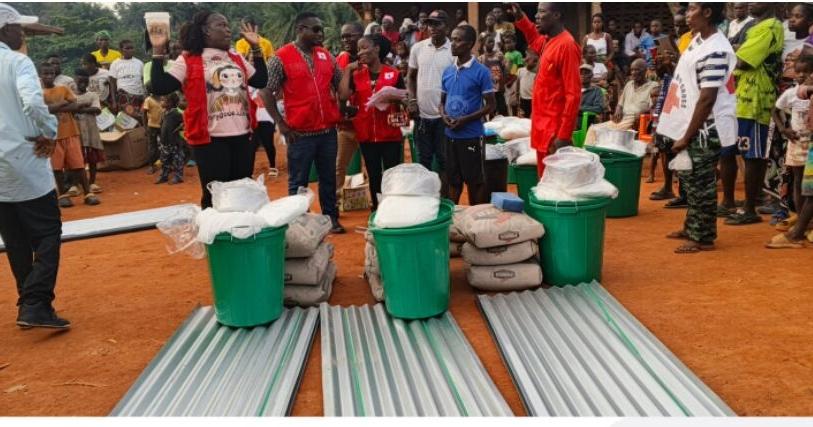
The Liberia National Red Cross Society (LNRCS) has concluded a major humanitarian intervention that provided cash assistance and essential relief supplies to 531 families affected by devastating fire outbreaks and windstorms earlier this year, while warning that an escalating flood emergency is now placing thousands more Liberians at risk.
Speaking during a press conference in Monrovia, LNRCS Secretary General and Chief Executive Officer Gregory T. Blamoh said the emergency response, implemented with support from the International Federation of Red Cross and Red Crescent Societies (IFRC), the European Union, and the Swedish Red Cross, reached 158 families affected by fire incidents and 373 families impacted by destructive windstorms across five counties. Of the total beneficiaries, 238 were female-headed households.
Blamoh said the intervention extended beyond immediate humanitarian assistance, helping affected families regain stability and begin rebuilding their lives.
“These achievements reflect not only the physical recovery of homes and livelihoods but also the emotional and social healing of families,” he said. “Many households have been able to secure rent, pay school fees, purchase food, and even start small businesses. Families can smile again, sleep safely, and look to the future with renewed confidence.”
Liberia endured two major natural disasters in March 2026 that left thousands of people displaced and without basic necessities.
Multiple fire outbreaks swept through communities in Grand Cape Mount, River Cess, Margibi, Nimba, and Montserrado counties, affecting 1,643 people and destroying or damaging 61 homes. Shortly afterward, a powerful windstorm struck Lofa and Nimba counties, affecting 3,704 people and damaging 213 houses.
The disasters left many families homeless overnight, destroying food stocks, household belongings, and livelihoods.
The LNRCS initially launched a local appeal seeking US$50,000 to support emergency operations. However, when the appeal fell short, the IFRC activated its Disaster Relief Emergency Fund (DREF), providing approximately US$520,000 to support the response about US$365,000 for the windstorm operation and US$170,000 for communities affected by the fires.
Under the windstorm response, each affected household received US$202 in cash assistance to address immediate needs. Families whose homes sustained damage also received between two and three bundles of zinc roofing sheets, nine to ten bags of cement, and household relief items including blankets, sleeping mats, mosquito nets, cooking utensils, water storage barrels, and drinking buckets.
For the fire response, 97 families renting or residing in affected structures each received US$227 in cash assistance to cover food and other essential expenses. Meanwhile, 61 homeowners whose properties were destroyed received US$572 each to support both shelter reconstruction and household recovery.
In Bethel Town, River Cess County, the Red Cross is supporting the construction of 27 more resilient homes using cement and stabilized earth bricks under its “Build Back Better” approach. Local artisans were also engaged to rehabilitate homes belonging to widows, single mothers, elderly women, and other vulnerable residents to ensure an inclusive recovery process.
Beyond shelter support, the organization trained 50 women organized into 10 backyard gardening groups in Climate-Smart Agriculture, benefiting 100 women across 10 communities as part of efforts to strengthen food security and build resilience to future climate-related disasters.
Communities also received sanitation tools, while rehabilitation of damaged water points remains ongoing to restore access to safe drinking water.
Blamoh credited the success of the intervention to the support of the IFRC, the European Union, the Swedish Red Cross, and the dedication of Red Cross volunteers and staff who worked throughout the emergency response.
While concluding the fire and windstorm recovery operation, the Liberia National Red Cross Society says its immediate priority is responding to severe flooding affecting Monrovia and several flood-prone communities as the rainy season intensifies.
On July 7, 2026, Red Cross emergency teams conducted a rapid needs assessment covering 233 households in two flood-affected communities.
The assessment revealed an alarming humanitarian situation. Nearly three-quarters of households reported flooding inside their homes, while 74 percent said their shelters had become unsafe. More than 90 percent lost stored food supplies, and 91 percent of drinking water sources were contaminated by floodwaters. In addition, 56 percent of households now depend on unsafe, unprotected wells, while 88 percent of communities surveyed were experiencing poor sanitation conditions.
The organization said the flooding has disproportionately affected female-headed households, older people, persons with disabilities, children under five, and low-income families, exposing them to heightened health and protection risks.
“The scale and severity of these findings make clear that the needs on the ground far exceed our current resources,” Blamoh said. “We are calling for urgent and increased support from government, development partners, and the Liberian public to expand emergency food assistance, restore safe water and sanitation services, and protect the safety and dignity of those bearing the heaviest burden of this crisis. Every day of delay deepens the suffering of families who have already lost their homes and livelihoods. The time to act is now.”
To strengthen its emergency response, the LNRCS has committed US$10,000 from its annual government allocation to support immediate flood relief operations, including food assistance, emergency shelter, and water, sanitation, and hygiene interventions.
However, Blamoh stressed that the funding remains insufficient compared to the growing humanitarian needs and appealed for increased national and international support.
Founded in 1919 and recognized by the Liberian government as an auxiliary to public authorities in humanitarian affairs, the Liberia National Red Cross Society plays a leading role in disaster preparedness, emergency response, health promotion, and community resilience across the country.
As climate-related disasters become increasingly frequent and severe, the organization says it will continue monitoring vulnerable communities nationwide while mobilizing additional resources to provide timely assistance throughout the remainder of the rainy season.
