By Stephen G. Fellajuah
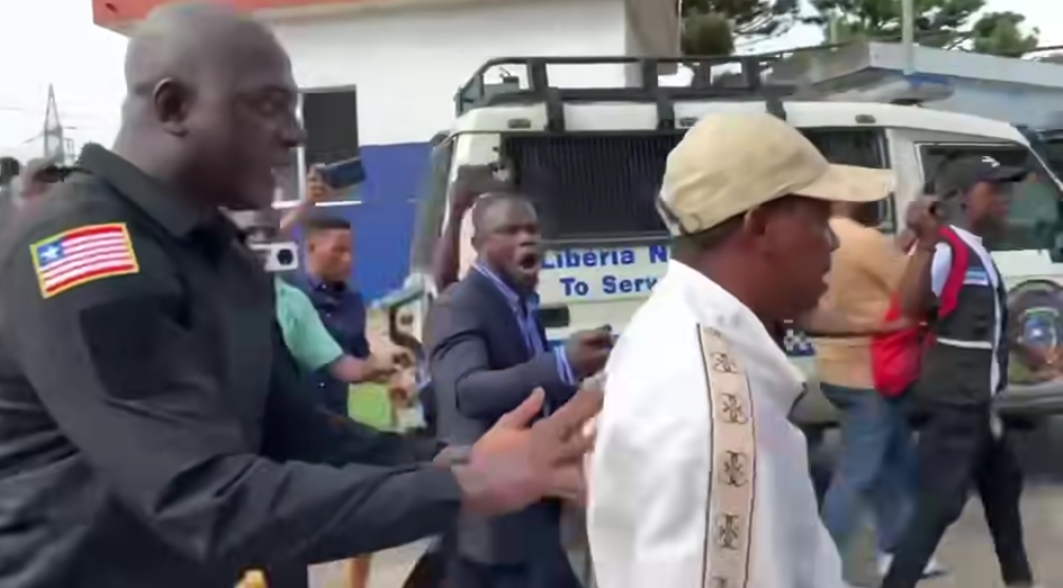
MONROVIA, Liberia, August 20, 2026: The headquarters of the Liberia National Police (LNP) became a scene of heightened political tension Wednesday when former Montserrado County District #8 Representative Moses Acarus Gray was escorted from the compound after arriving to show solidarity with former Vice President Jewel Howard Taylor.
Gray arrived at Police Headquarters around midday as Taylor was being questioned by investigators in connection with the ongoing cocaine investigation.
Shortly after entering the compound, security officers approached the former lawmaker and instructed him to leave. When Gray did not immediately comply, officers escorted him through the gate as Congress for Democratic Change (CDC) partisans, journalists and other onlookers gathered outside the facility.
The incident unfolded amid growing political tensions surrounding the cocaine investigation and Taylor’s questioning by police.
Taylor had earlier been prevented from leaving Liberia while preparing to travel to Accra, Ghana, where she was expected to attend a women’s forum.
She subsequently reported to police after being instructed to do so, saying she was complying with the directive.
Information Minister Jerolinmek M. Piah initially confirmed that Taylor was being treated as a person of interest in the ongoing investigation.
The government later announced that the former Vice President had been charged under several provisions of the Controlled Drug and Substance Act of 2023, the Penal Law of Liberia and the Anti-Money Laundering and Terrorist Financing Law.
The charges include allegations of unlicensed importation and transportation of controlled drugs, illicit trafficking, criminal solicitation, criminal facilitation, criminal conspiracy and money laundering.
The government has stressed that the charges are accusations and that Taylor remains presumed innocent unless and until proven guilty by a court of competent jurisdiction.
Political Battle Intensifies
Taylor’s questioning and subsequent charges triggered sharp reactions from both the governing Unity Party and opposition politicians.
The Unity Party endorsed the police action, arguing that the investigation demonstrates that no individual should be shielded because of political affiliation, former public office or economic status.
The party accused some opposition figures of attempting to politicize the investigation by portraying arrests and invitations for questioning as a witch hunt.
It urged opposition leaders with credible information concerning the cocaine case to submit it to the Joint Security or the courts rather than interfere with the investigation.
The ruling party also called on security personnel involved in the probe to remain professional, apolitical and committed to their constitutional responsibilities.
According to the Unity Party, the government will continue investigating drug-related activities and pursue anyone against whom evidence is established, regardless of political affiliation or status.
Opposition politicians, however, sharply criticized the government’s handling of the investigation.
Representative Marvin Cole described the government’s action as an “unprofessional cover-up” and called for Vice President Jeremiah Kpan Koung to also be questioned in connection with the cocaine investigation.
Representatives Abu Kamara and Eugene Kollie expressed confidence in Taylor’s innocence and rejected suggestions that she was involved in alleged drug trafficking activities.
CDC Chairman Janga Augustus Kowo also condemned the government’s action, describing its approach as a strategy that was “dead on arrival.”
Kowo accused the government of attempting to intimidate opposition figures and use Taylor as a scapegoat in the cocaine investigation.
He pointed to the dismissal and suspension of government and security officials in connection with the investigation, arguing that those developments raise broader questions about accountability within the government.
Kowo maintained that the police could not intimidate the opposition and demanded full accountability for government officials and security personnel linked to the investigation.
The developments have further intensified the political controversy surrounding Liberia’s multimillion-dollar cocaine investigation, with opposition figures demanding that the probe extend to government officials and other individuals they believe should face scrutiny.
The government, meanwhile, maintains that the investigation will be conducted without regard to political affiliation, former office, economic standing or social status.
See more Liberia News Network stories in Google Search by adding LNN as one of your Preferred Sources.
★ Add LNN as a Preferred Source