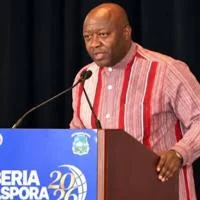
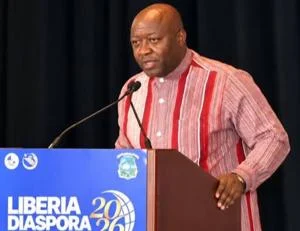
Finance and Development Planning Minister Augustine Kpehe Ngafuan has urged Liberians in the diaspora and international investors to look beyond Liberia’s troubled past and focus on what he described as a country emerging with stronger institutions, improved fiscal capacity and significant untapped investment opportunities.
Speaking at the Liberian Diaspora Conference in Washington, D.C., on September 26, 2026, under the theme “Making an Investment Case for Liberia—Betting on Liberia,” Ngafuan said Liberia’s investment story is increasingly defined by sustained peace, improving macroeconomic conditions, infrastructure development, digital transformation and abundant natural resources.
“Because Liberia offers a rare combination: growing stability and unfinished opportunity; improving institutions and first-mover advantage; abundant resources and a government determined to convert them into jobs and shared prosperity,” Ngafuan told the gathering.
The Finance Minister used the imagery of a driver looking through a windshield rather than constantly checking the rear-view mirror to describe Liberia’s transformation.
He acknowledged the country’s history of civil conflict, destroyed infrastructure and economic collapse, but argued that Liberia has since sustained peace for more than two decades, conducted competitive elections, peacefully transferred presidential power and rebuilt democratic institutions.
Liberia’s current membership as a non-permanent member of the United Nations Security Council, he said, demonstrates how far the country has moved from its conflict-era image.
“A nation once defined in global headlines by conflict is now helping to deliberate on peace and security for the world,” Ngafuan said, adding that Liberia is “no longer merely a country emerging from crisis,” but one “advancing with purpose.”
Central to his investment pitch was Liberia’s improving fiscal position.
Ngafuan said the economy grew by about 5.1 percent in 2025, while the International Monetary Fund projects approximately 5.5 percent growth in 2026, driven particularly by mining, construction and manufacturing. He also cited average inflation of about 4.5 percent during the first half of 2026 and broadly stable movement of the Liberian dollar.
He said the IMF projects Liberia’s primary fiscal surplus, excluding grants, at approximately 2.4 percent of GDP in 2026.
Ngafuan also pointed to improvements in budget preparation and execution, saying the government has passed national budgets before the beginning of the fiscal year for two consecutive years and that entities meeting government commitment and procurement requirements have greater certainty that their budgeted funds will be released.
He linked improved payment discipline to investor confidence, saying timely government payments allow firms to pay workers, banks to lend with greater confidence and projects to remain on schedule.
The minister placed particular emphasis on Liberia’s historic domestic revenue performance.
Liberia crossed the US $ 1 billion domestic revenue threshold for the first time in its history on September 14, 2026, according to the Liberia Revenue Authority (LRA) and 612 million in 2023 to US$699 million in 2024 and approximately US $ 848million in 2025 before surpassing the billion-dollar mark in September 2026.
Ngafuan cautioned, however, that the milestone should not be mistaken for an end to Liberia’s development challenges.
“Collecting one billion dollars does not mean Liberia has no more problems,” he said, stressing that revenue must finance salaries, education, healthcare, security, infrastructure, county development, debt service and other national obligations.
He described the milestone as “proof of capacity—and a summons to greater responsibility.”
The minister tied the government’s investment strategy to the ARREST Agenda for Inclusive Development, emphasizing agriculture, roads, rule of law, education, sanitation and health, and tourism.
He highlighted ongoing road construction, including a 255-kilometer western corridor network, the planned Cavalla River bridge linking Liberia and Côte d’Ivoire, road equipment for all 15 counties, an overpass in Monrovia, and investments in schools and hospitals.
Energy and industrial development also featured prominently in his pitch.
Ngafuan said electricity access has expanded from about 32 percent in 2024 toward 40 percent, while Buchanan has been energized and progress is being made in Voinjama and other communities.
He also highlighted the Special Agro-Industrial Processing Zone in Buchanan, which is intended to provide processing capacity for rice, cocoa, oil palm, fisheries and other products.
“Our aim is straightforward: Liberia must not remain a country that exports raw potential and imports finished prosperity,” he said. “We must add value at home.”
Ngafuan further pointed to financial technology as part of the country’s emerging investment infrastructure.
He said the Central Bank of Liberia’s Inclusive Instant Payment System, launched in December 2025 with Lonestar Cell MTN and Orange Money, processed more than 1.5 million transactions worth over L1.4billionandUS9 million during its first three months.
The full National Electronic Payment Switch is targeted for March 2027 and is expected to connect commercial banks, mobile-money platforms, government-payment channels and other financial institutions.
Ngafuan said the system would make payments faster and more transparent while supporting tax collection and reducing leakages.
He also cited the 2026 Public Procurement and Concessions Act as providing an improved legal foundation for public-private partnerships, concessions management and electronic government procurement.
Among the investment opportunities he identified were energy, roads, ports and logistics, housing, agro-processing, mining services and beneficiation, manufacturing, digital infrastructure, tourism, fisheries and the blue economy.
He said Liberia’s approximately 580 kilometers of Atlantic coastline, forests, iron ore, gold, rubber and agricultural land provide opportunities for investment and value addition.
The minister acknowledged that challenges remain, including high electricity costs, infrastructure gaps, bureaucracy, limited access to finance and the need for greater regulatory predictability.
“Are we perfect? No,” Ngafuan said. “We do not present Liberia as a country without problems. We present Liberia as a country increasingly capable of solving problems.”
He also placed the Liberian diaspora at the center of the investment strategy, urging Liberians abroad to move beyond remittances for consumption toward productive investment.
“We need your savings in Liberian enterprises; your networks opening markets; your professionals transferring knowledge; and diaspora-led partnerships in agribusiness, logistics, housing, tourism, healthcare, education, energy and digital services,” he said.
Ngafuan cautioned diaspora investors not to invest blindly because Liberia is home, but encouraged them to conduct due diligence, demand sound numbers and structure investments professionally.
“Do not only send money home. Build home,” he told the diaspora.
He said Liberia needs capital that is “patient but not passive; profitable but not predatory; ambitious but also responsible.”
Concluding his address, Ngafuan framed the investment case around Liberia’s peace, economic growth, improving fiscal capacity, infrastructure development, natural resources and people.
“The investment case for Liberia is not a promise that risks have disappeared,” he said. “It is the case that the direction has changed—and that the upside of getting in early is becoming more compelling.”
He urged investors, development partners and Liberians abroad to engage with the country’s emerging opportunities.
“Let us bet on Liberia—not blindly, but boldly, responsibly and together,” Ngafuan declared.
See more Liberia News Network stories in Google Search by adding LNN as one of your Preferred Sources.
★ Add LNN as a Preferred Source