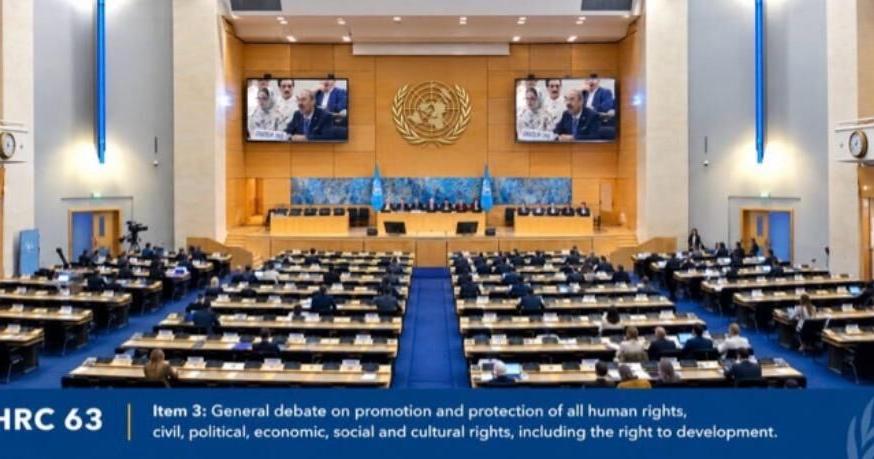
The pretrial detention of 95-year-old Lee Man-hee, founder and chairman of the Shincheonji Church of Jesus, has been brought before the United Nations Human Rights Council (UN-HRC), with an international rights organization urging South Korea to reconsider his continued detention and ensure that his case is handled in accordance with international human rights standards.
CAP Freedom of Conscience raised Lee’s case on September 18, 2026, during the general debate under Item 3 of the 63rd session of the UN Human Rights Council, which addresses the promotion and protection of all human rights. The organization expressed concern not only about the legal proceedings against Lee but also about his age, health and reported conditions of detention.
Lee, a veteran of the Korean War and leader of the South Korean religious movement, has been held in pretrial detention at the Seoul Detention Center following a court decision in June. South Korean investigators accuse him of involvement in a campaign that allegedly pressured tens of thousands of Shincheonji followers to join the conservative People Power Party (PPP) in an effort to influence internal party elections.
According to Yonhap News Agency, investigators allege that at least 56,472 church members were forced to join the PPP between July 2021 and January 2024, including during the party’s 2022 presidential primary and 2024 general-election primaries. Lee was indicted under detention on June 29 on charges including violations of the Political Parties Act and obstruction of business.
While the South Korean authorities’ allegations form the legal basis of the case, CAP Freedom of Conscience has shifted attention to a broader question: whether Lee’s continued pretrial detention is necessary and proportionate, particularly given his advanced age.
The organization described the investigation as appearing to be politically driven and discriminatory toward a religious minority. It also questioned whether detention was justified in circumstances where Lee has a fixed residence and, according to the organization, poses no flight risk.
The concerns are particularly focused on Lee’s reported treatment during Seoul’s severe summer heat. CAP Freedom of Conscience said the elderly detainee was held in cells without air conditioning during the heatwave, raising concerns about the potential impact on his health.
The organization is therefore seeking scrutiny not only of the allegations against Lee but also of the conditions under which he is being detained.
The South Korean authorities have provided a different justification for Lee’s detention.
When the Seoul Central District Court approved the detention warrant in June, reports said the court cited concerns about potential evidence tampering. KBS reported that the court granted the prosecution-police team’s request despite Lee’s age of 95.
The joint investigation subsequently expanded beyond the political-party allegations. In July, Lee was additionally indicted over allegations of tax evasion involving approximately 7.5 billion won in taxes, according to the Seoul Economic Daily.
The investigation was formally concluded by the joint prosecution-police team on August 31 after 237 days. Yonhap reported that the investigation examined alleged political-religious collusion, including accusations involving Shincheonji’s recruitment of members into the PPP, tax evasion and embezzlement.
Lee and Shincheonji have rejected the allegations. In a June statement following the detention order, the church argued that Lee had a fixed address, had cooperated with investigators and presented no flight risk. The church also expressed concern about his health and said he required regular medical support and care.
CAP Freedom of Conscience framed its intervention around several international human-rights instruments.
The organization pointed to Article 9 of the International Covenant on Civil and Political Rights (ICCPR), which addresses arbitrary detention and requires restrictions on liberty to meet legal and proportionality standards. It also cited Article 10, concerning humane treatment of people deprived of their liberty, and Article 18, which protects freedom of thought, conscience and religion.
The organization further invoked the Nelson Mandela Rules, which establish internationally recognized minimum standards for the treatment of prisoners, and the Tokyo Rules, which promote non-custodial measures and emphasize that pretrial detention should be used only when necessary.
CAP Freedom of Conscience argues that these standards are particularly relevant because the case involves an elderly religious leader facing allegations that, while serious, are non-violent.
The case has also acquired a religious-freedom dimension because Lee is the founder and leader of Shincheonji, a controversial South Korean religious movement.
CAP Freedom of Conscience contends that the investigation must not result in discriminatory treatment because of Lee’s religious affiliation or the status of Shincheonji as a minority religious movement.
That argument does not determine whether the allegations against Lee are valid. Rather, it raises the separate human-rights question of whether criminal investigations involving religious organizations are being conducted impartially and whether religious belief and association are being adequately protected during the process.
The distinction is important because the Human Rights Council’s consideration of the matter does not amount to a judicial finding on Lee’s guilt or innocence. The Council debate provides a forum for raising human-rights concerns, while the determination of the criminal allegations remains a matter for South Korea’s judicial system.
Against this backdrop, CAP Freedom of Conscience called on South Korean authorities to consider alternatives to continued pretrial detention.
Its recommendations include an independent medical assessment of Lee, consideration of non-custodial measures, and guarantees that the eventual trial will be fair and impartial.
The organization argues that such measures would allow South Korea to pursue the criminal investigation while also addressing concerns arising from Lee’s advanced age and health.
The controversy therefore places two principles in tension: the state’s responsibility to investigate alleged political interference and other potential offenses, and its obligation to ensure that the treatment of an accused person complies with domestic law and international human-rights standards.
Lee’s case comes at a politically sensitive moment in South Korea, where authorities have been investigating alleged links between religious organizations and political activity. The joint investigation that detained Lee also examined allegations involving the Unification Church, including alleged illegal political donations and financial misconduct.
For CAP Freedom of Conscience, however, Lee’s detention has become a test of how South Korea balances criminal accountability with protections for vulnerable detainees and religious minorities.
The organization’s intervention before the Human Rights Council does not seek to determine the merits of the criminal charges. Instead, it asks whether the state can pursue those charges while respecting the principles of necessity, proportionality, humane detention, medical care, religious freedom and due process.
As Lee’s proceedings continue, the case is likely to remain under international observation, particularly because of his age and the competing claims surrounding the necessity of his detention.
The central issue raised before the Human Rights Council is therefore not whether Lee Man-hee should be above the law, but whether the pursuit of accountability can be reconciled with the Republic of Korea’s obligations to protect human dignity, due process and freedom of religion or belief.
See more Liberia News Network stories in Google Search by adding LNN as one of your Preferred Sources.
★ Add LNN as a Preferred Source