Did Liberia Misread a Political Outsider Whose Style Was Different From His Record?
MONROVIA — George Weah’s presidency continues to provoke a fascinating debate in Liberia—one that may ultimately have less to do with dancing and singing than with how Liberians judge political leadership.
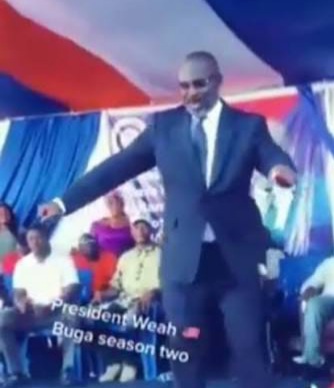
Throughout his presidency, Weah was frequently criticized for his informal public style.
He danced.
He sang.
He joked.
He celebrated.
He sometimes behaved more like the internationally celebrated football icon Liberians had known for decades than the traditionally restrained political figure many expected to occupy the Executive Mansion.
For some members of Liberia’s political and intellectual class, that became evidence that Weah did not sufficiently understand the dignity and seriousness associated with the presidency.
But there is another side of the Weah presidency that deserves equal examination:
What was the man who danced actually building?
The answer is more complicated than the caricature.
Beyond the dancing
Under Weah, Liberia undertook a substantial expansion of road construction and rehabilitation.
In 2018, his administration secured legislative approval for financing agreements covering an intended 830-kilometre road network. The projects included major corridors such as Buchanan–Cestos–Greenville–Barclayville, Zwedru–Greenville, Tappita–Zwedru, Tubmanburg–Bopolu and other roads.
The Japanese-supported Somalia Drive project also moved forward under his administration. Phase I covered 13.2 kilometres, expanding the road from two lanes to four and including bridge rehabilitation.
By 2023, Weah was claiming that his government had constructed more community roads than any government in Liberia’s history and had completed more than 347 kilometres of primary roads during his first five and a half years.
But there is an important qualification.
Public Works Minister Ruth Coker-Collins gave a different figure, saying Liberia’s paved-road network had increased from 745 kilometres before 2018 to 1,275 kilometres under the Weah administration—an increase of approximately 530 kilometres.
A 2023 fact-check found that this figure contradicted then-Finance Minister Samuel Tweah’s claim of 627 kilometres.
The discrepancy deserves further investigation, but it does not erase the broader point:
Road construction was a major feature of the Weah presidency.
Then came the hospitals
Weah’s infrastructure record was not limited to roads.
His administration launched and completed the 14 Military Hospital, Liberia’s first military hospital.
The project was conceived as a more than 200-bed facility and was eventually dedicated in September 2021.
His administration also began work on a new Redemption Hospital in Caldwell. In 2018, the Executive Mansion described the project as one of two major hospital projects initiated within Weah’s first six months in office.
The 14 Military Hospital has continued operating as a major healthcare facility. The U.S. Army later described it as one of Liberia’s important healthcare facilities.
Again, reasonable criticism can be made about the cost, implementation, quality, utilization or sustainability of any public project.
But dismissing the infrastructure component of the presidency because the president liked to dance would leave out an important part of the historical record.
The footballer never disappeared
Perhaps this is where the Weah presidency became uncomfortable for parts of Liberia’s traditional political culture.
Weah never completely abandoned the personality that made him famous.
He was the footballer who became president.
He did not suddenly become a career bureaucrat.
He carried his football identity into the presidency. Even the name of the 14 Military Hospital was connected to the number 14 he wore during his football career.
His opponents could regard that as excessive informality.
His supporters could regard it as authenticity.
Both interpretations can coexist.
But did Liberians not know whom they were electing?
This question is rarely examined carefully enough.
When Liberians elected Weah in 2017, they were not electing an unknown technocrat.
They were electing one of the most famous Liberians in history—a football superstar whose public personality was already well established.
His supporters knew his background.
They knew his mannerisms.
They knew his popularity.
They knew he was different from the traditional Liberian politician.
And yet they elected him president.
That fact matters when assessing subsequent criticism of his personality.
The 2023 election complicates the story even further
Weah’s political story did not end with his defeat.
The National Elections Commission’s official results show that in the first round of the 2023 presidential election, Weah received 804,087 votes, or 43.83 percent, narrowly ahead of Joseph Boakai’s 796,961 votes, or 43.44 percent.
He ultimately lost the runoff.
But the first-round result demonstrates that after six years in office, the president who had been repeatedly criticized for his personality remained capable of attracting an enormous share of the national vote.
That fact should make Liberia cautious about simplistic explanations of Weah’s political appeal.
It raises a deeper question.
Was Weah a political outsider who disrupted Liberia’s traditional establishment?
This is where the intellectual debate becomes interesting.
Weah entered national politics from outside Liberia’s traditional political and intellectual establishment.
He did not emerge from the country’s conventional bureaucratic or academic pathway into power.
He came from football.
He became an international celebrity.
Then he entered politics.
His language was often different.
His public behavior was different.
His relationship with ordinary Liberians was different.
And his presidency challenged traditional ideas about what a Liberian president was supposed to look and sound like.
Could some of the criticism of his personality therefore have been partly a class and cultural reaction to a political outsider occupying the highest office in the land?
That is a question—not an established fact.
There is certainly no basis for claiming that every intellectual critic of Weah opposed him because of his background. His administration faced legitimate and documented criticisms involving governance, corruption, economic management and other policy issues.
But it is equally reasonable to ask whether the focus on dancing, singing and celebrity sometimes overshadowed a serious examination of what the government was actually doing.
The danger of judging a presidency by personality
This may be the greatest lesson from the Weah era.
A president can dance and still build a road.
A president can sing and still build a hospital.
A president can joke with ordinary citizens and still sign major infrastructure agreements.
Conversely, a president can behave with extraordinary dignity and seriousness in public while still making policy decisions that deserve intense scrutiny.
Public demeanor is not the same thing as governance.
That distinction matters.
The appropriate question is therefore not:
“Did George Weah dance too much?”
It is:
“What did the Weah administration accomplish, what did it fail to accomplish, what did those projects cost, who benefited, and what was the quality of governance behind them?”
That is the harder question.
And it is the question Liberia should continue asking.
The Weah paradox
Perhaps the most interesting thing about George Weah’s presidency is precisely the contradiction.
The man who was mocked for dancing was also presiding over one of Liberia’s most ambitious periods of road construction in recent decades.
The footballer who was criticized for his informal personality became the president who dedicated Liberia’s first military hospital.
The celebrity who was accused of being more interested in entertainment than politics remained sufficiently politically influential to receive 43.83 percent of the first-round presidential vote in 2023, before losing the runoff.
That does not prove that Weah was a successful president.
Nor does it prove that his critics were wrong.
But it does demonstrate that the story of George Weah cannot be reduced to a dancing president.
Liberia may ultimately remember Weah not simply as the footballer who entered the Executive Mansion, but as a political outsider whose unconventional style forced the country to confront a difficult question:
Does Liberia judge its presidents more by how they behave—or by what they leave behind?
That question remains open.
And perhaps that is the real Weah paradox.
See more Liberia News Network stories in Google Search by adding LNN as one of your Preferred Sources.
★ Add LNN as a Preferred Source