
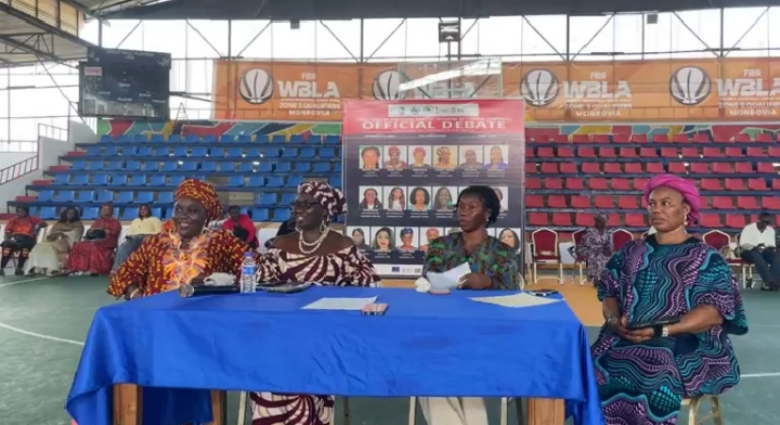
SKD GYMNASIUM, PAYNESVILLE CITY – As women from different political parties prepare to elect new leaders for the Coalition of Political Parties Women in Liberia (COPPWIL), Bong County Electoral District #6 Representative Moima Briggs-Mensah has challenged them to put aside personal ambitions and demonstrate the unity needed to advance women’s leadership, while United Nations Women (UN Women) Liberia Representative Yemi Falayajo has questioned political parties’ commitment to giving women meaningful opportunities to win elected positions.
The two women delivered their messages at the COPPWIL Leadership Candidates Debate. In the their remarks both Briggs-Mensah and Falayajo highlighted two challenges facing the women’s political movement: divisions and personal interests among women seeking leadership, and the continued failure of political parties to translate women’s numerical strength as voters into greater representation in elected offices.
The debate was organized by Sister Aid Liberia in collaboration with UN Women, the United Nations Development Programme (UNDP), the National Elections Commission (NEC) and the Women’s Legislative Caucus of Liberia, among other partners. It was held ahead of COPPWIL’s elections scheduled for Friday, November 20, 2026 as 19 women contest eight positions, ranging chaplain to the presidential candidate seats.
Briggs-Mensah Questions Leadership Beyond Positions
Representative Briggs-Mensah urged the candidates to look beyond the positions they hope to occupy and focus instead on what they can contribute to COPPWIL and the broader struggle for women’s political representation.
She warned that an election intended to strengthen women’s leadership could lose its purpose if candidates allow personal ambitions to create divisions within the organization.
For Briggs-Mensah, the contest should be an opportunity for aspirants to demonstrate their leadership abilities, preparedness and plans for improving the coalition rather than simply compete for titles.
“Now, let’s be about winning positions. It should be about showcasing our competence, our readiness, our ambition and how well we are going to lead COPPWIL to improve and increase women’s leadership in Liberia,” she said.
Her remarks placed responsibility on the candidates to explain what they intend to do if elected, particularly at a time when women continue to demand greater participation in the country’s political decision-making.
She cautioned that the importance of leadership must not be measured by the position a person holds but by the contribution that person makes to the organization and the people it represents.
“Our ambition should be greater than the position we sit in,” Briggs-Mensah said. “The leadership we want to present should be bigger than individual interest.”
The Bong County Lawmaker also called for fairness in the electoral process and urged members to respect one another despite their differences. She stressed that the relationships built during the campaign should not end when the votes are counted.
Her appeal raises an important question for the coalition: whether women who campaign against political exclusion can maintain the same spirit of solidarity when competing for leadership among themselves.
Briggs-Mensah urged members to remain united after the November 20 elections and work together to strengthen COPPWIL’s role in promoting women’s participation in national leadership.
UN Women Challenges Political Parties Over Representation
While Briggs-Mensah focused on unity within the coalition, Falayajo turned attention to the political parties that determine who receives support and opportunities to contest elections.
She said women constitute more than 50 percent of Liberia’s voting population but remain significantly underrepresented in elected positions. The imbalance, she argued, exposes a gap between women’s participation in choosing political leaders and their access to the positions where decisions are made.
Falayajo challenged political parties to explain why women continue to play major roles in mobilizing voters and supporting campaigns but are not given comparable opportunities to become elected representatives.
Figures she cited showed that only two of Liberia’s 31 political parties met the 30 percent gender quota during the 2023 elections.
The figures, she suggested, should concern political parties and women leaders because they point to the difficulty of turning commitments to gender inclusion into actual political representation.
“So we cannot continue to mobilize women to vote when we don’t see women in power. We cannot continue to enable the imbalance of the power dynamics,” she said.
Her criticism goes beyond the number of women who participate in elections. It points to the role political parties play in determining which candidates receive nominations, resources, campaign support and opportunities to compete.
Falayajo said parties must do more than encourage women to vote. They must also create conditions that allow women to be voted for and elected.
She questioned the opportunities available to women in parties that failed to meet the gender quota, challenging political leaders to take responsibility for improving representation rather than leaving the burden on women candidates themselves.
The UN Women representative also warned against competition among women that limits opportunities for others. She said women should not view leadership positions as small spaces that one woman must occupy at the expense of another. “All of us cannot be fighting for one small space when we can open up the spaces for other women to participate,” she said.
Falayajo urged women leaders to support one another and work toward expanding political opportunities across party lines. “We are not going to start preparing to look at that woman on the street, how we are going to remove her, so that somebody else can sit there. Let’s create more spaces for women,” she added.
Training Alone Cannot Resolve Political Barriers
Falayajo also outlined UN Women’s efforts to prepare women for political leadership, including training for aspiring female candidates from different political parties and members of COPPWIL.
She said the initiative is informed by country-level mapping of women aspirants and is intended to strengthen their preparedness for political campaigns and leadership responsibilities.
However, she acknowledged that training is only one part of the challenge. Women continue to face financial, institutional, cultural and personal barriers that can prevent them from competing effectively.
Those challenges require more than encouraging women to become politically active. They also demand changes within political parties and stronger cooperation among institutions responsible for elections and political reforms.
Falayajo called for collaboration with the National Elections Commission, the Women’s Legislative Caucus and political party leaders through the Inter-Party Consultative Committee to address barriers affecting women’s participation.
She also commended COPPWIL for reviewing its strategic plan and constitution, validating its membership and taking steps to strengthen its internal governance. She recognized the Women’s Legislative Caucus for promoting cooperation among women from different political parties.
Falayajo said women’s representation could improve if women leaders used their collective influence to demand more space in political leadership. “That 11% can be 21%. You can have 31%. You can have 51%. But we need your collective voice, your collective cooperation,” she said.
Her remarks reinforced the need for women to work together, but also placed pressure on political parties to demonstrate that their support for gender inclusion goes beyond public statements.
Four Women Contest COPPWIL Presidency
The debate brought together aspirants seeking different leadership positions within COPPWIL, allowing them to present their plans and respond to questions about leadership, accountability, internal governance and the future direction of the coalition.
Four women are contesting the presidency: Selena P. Mappy, Victoria T. Koiguah, Willette P. Cooper and Kebbeh Collins.
Other aspirants are seeking positions including Vice President for Administration, Vice President for Operations, Secretary General and Treasurer.
The November 20 elections will determine the coalition’s next leadership at a time when the demand for greater women’s representation remains a major issue in Liberia’s political space.
But beyond the outcome of the election, the coalition faces the task of proving that it can unite women across political party lines and turn its advocacy into meaningful political influence.
See more Liberia News Network stories in Google Search by adding LNN as one of your Preferred Sources.
★ Add LNN as a Preferred Source