
MIDA introduces four proposed power plants, three reservoirs, 305 kilometers of transmission lines and major grid improvements as administration advances ARREST Agenda
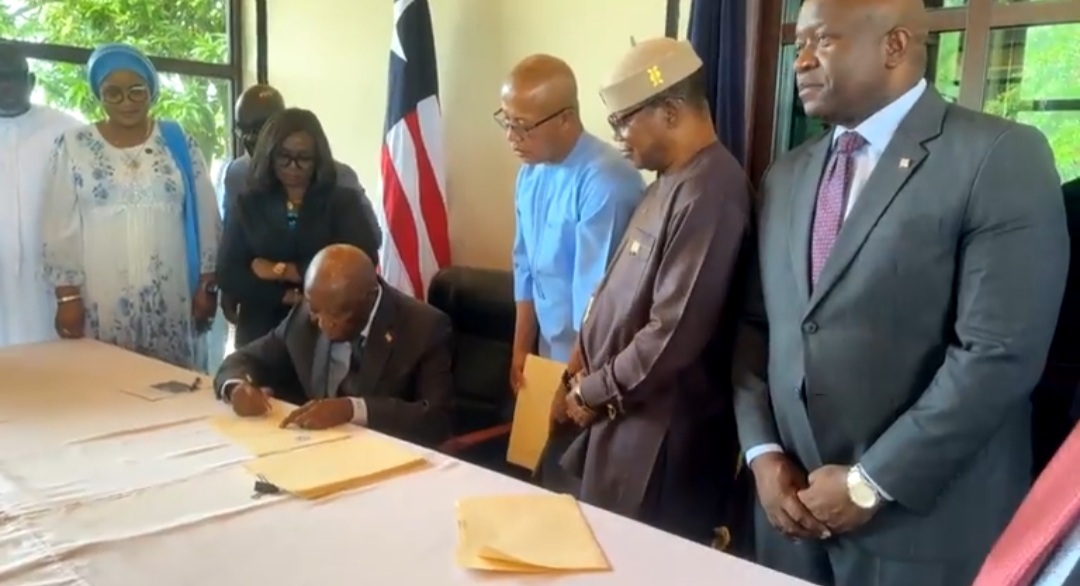
MONROVIA, LIBERIA – President Joseph Nyuma Boakai has signed a US$5.7 billion Master Infrastructure Development Agreement (MIDA) with Bea Mountain Mining Corporation (BMMC), advancing one of the largest infrastructure financing arrangements in Liberia’s history and placing electricity generation, transmission expansion, and national connectivity at the center of his administration’s development programme.
The agreement, signed Wednesday, November 25, 2026, at the Tea House of the Executive Mansion in Monrovia, follows months of negotiations coordinated by the Inter-Ministerial Concessions Committee and now moves to the National Legislature for ratification before implementation can begin.
The agreement is designed to address some of Liberia’s longstanding infrastructure constraints through a combination of hydropower development, biomass electricity generation, transmission infrastructure, road construction, and national grid improvements.
Its most consequential component is the proposed addition of 270 megawatts of electricity-generating capacity through four power plants, an intervention that could substantially change the country’s electricity supply capacity if successfully implemented.
According to the Ministry of Information, the programme comprises three hydropower facilities and one biomass plant, supported by three reservoirs with a combined storage capacity of approximately 10 billion cubic meters.
The proposed energy programme includes a 100-megawatt hydropower facility on the Via River, two hydropower facilities on the St. Paul River with combined capacity of 110 megawatts, and a 60-megawatt biomass power plant near the proposed Via dam.
The Via River facility and the SP-3 hydropower plant are each designed to produce 100 megawatts, while SP-4 is expected to contribute another 10 megawatts.
Together, the three hydropower facilities would provide 210 megawatts, with biomass supplying the remaining 60 megawatts.
The proposed reservoirs are particularly important because they are intended to help regulate water availability for electricity generation during periods of reduced rainfall.
Liberia’s existing electricity generation has faced limitations associated with seasonal changes in river flows. The Ministry of Information has explained that low reservoir levels during dry periods affect the output of Mount Coffee Hydropower Plant, making additional water storage an important component of the proposed energy programme.
The reservoirs are therefore intended to support more consistent hydropower generation by storing water during periods of higher river flows and releasing it when conditions become less favorable.
The success of this component will depend on reservoir management, rainfall patterns, engineering performance, and the operational capacity of the electricity sector.
Beyond generating additional electricity, MIDA proposes significant investment in the infrastructure required to transmit power from production facilities to the national grid.
The programme includes approximately 305 kilometers of high-voltage transmission lines through three major projects.
A 150-kilometer Main Transmission Line is expected to connect the power facilities to the existing Mount Coffee substation. Another 150-kilometer line is planned to link the Via power plant to Nimba County, while a five-kilometer transmission connection is intended to support electricity delivery toward Bong County.
The agreement also provides for up to US$230 million in national grid improvements involving substations, transformers, and the 66-kilovolt network serving Monrovia.
These investments are important because electricity generation alone cannot resolve Liberia’s power challenges without adequate transmission and distribution systems.
For households, improved electricity supply could reduce dependence on expensive alternative energy sources. For hospitals, reliable electricity is essential for medical equipment, laboratories, refrigeration, and emergency services. Businesses, manufacturers, hotels, educational institutions, and other productive sectors could also benefit from a more dependable electricity system.
The proposed investment therefore has implications extending beyond the energy sector into employment, industrial production, public service delivery, and the cost of doing business.
MIDA also places road development alongside electricity expansion as a central pillar of the infrastructure initiative.
One of its principal road projects is the 146-kilometer Liberia Development Road, valued at approximately US$234.6 million in the project breakdown published by The Liberian Investigator.
The agreement further identifies an additional road investment envelope of up to US$1 billion covering proposed roads and bridges in several counties.
These include proposed connections involving Bomi, Gbarpolu, Bong, Nimba, Grand Bassa, Sinoe, Lofa, and Grand Cape Mount, alongside projects in Monrovia.
The road component is intended to improve transportation links, facilitate movement between communities, connect agricultural production areas to markets, and support economic activity around major infrastructure facilities.
The Government says additional revenue payable by Bea Mountain, associated with higher gold prices, will be directed toward financing the infrastructure programme while the company continues making its regular contributions to the Consolidated Account.
Detailed reporting on the agreement indicates that BMMC will finance eligible infrastructure works and recover approved expenditure through specified government revenue entitlements. The reported framework allows financing of up to US$500 million in outstanding work at any one time, with unrecovered balances attracting interest at three-month SOFR plus two percentage points.
This financing structure makes legislative examination particularly important. Lawmakers will need to assess the revenue recovery provisions, project costs, financing charges, delivery obligations, and the potential effect on government revenue over the implementation period.
The distinction between the total programme value and the amount outstanding at any one time is also important for understanding the financial structure.
The agreement aligns with several objectives of President Boakai’s ARREST Agenda for Inclusive Development, particularly roads, energy, economic growth, and investment in productive infrastructure.
By combining power generation, transmission systems, and road development under one programme, the administration is seeking to address infrastructure constraints that have historically limited Liberia’s economic potential.
Improved electricity supply could support industrialization, encourage private-sector investment, strengthen small businesses, and create opportunities for agricultural processing and other productive activities.
Better roads could reduce transportation costs, improve access to markets, and strengthen economic connections between counties.
The agreement also anticipates employment and skills development opportunities for Liberians in engineering, construction, electricity generation, and power operations. The project breakdown indicates that up to 50 Liberians are expected to receive overseas training, primarily in Türkiye, followed by practical training in Liberia.
The President’s signing therefore marks an important development in the administration’s infrastructure programme, but the next stage will be equally consequential.
The Legislature must determine whether the agreement provides sufficient protection for public revenue, establishes enforceable construction standards, and guarantees measurable benefits for the Liberian people.
For the administration, the challenge will be to translate the proposed investment into completed infrastructure, dependable electricity, improved roads, employment, and stronger economic opportunities.
The measure of MIDA will not be the amount announced at its signing but the quality and accessibility of the infrastructure delivered across Liberia.
See more Liberia News Network stories in Google Search by adding LNN as one of your Preferred Sources.
★ Add LNN as a Preferred Source