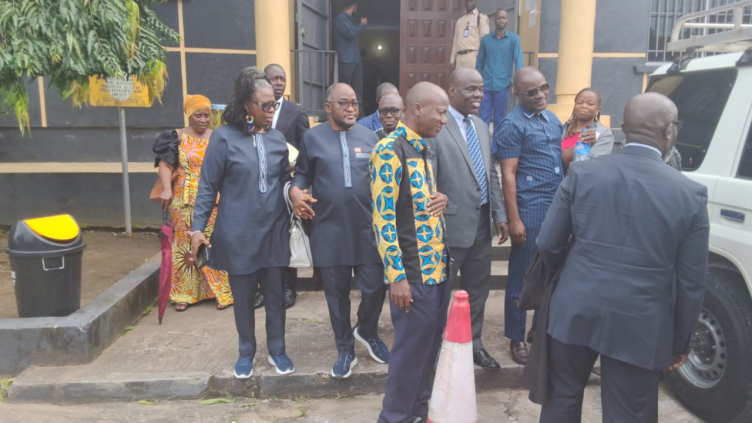
MONROVIA — The long-running trial involving the alleged misappropriation of Saudi-donated rice has entered its final stage, with the prosecution and defense scheduled to deliver closing arguments before the jury on Friday, October 9, 2026, at 8:00 a.m.
The development followed Wednesday’s sitting before Criminal Court “C,” where the prosecution presented its final rebuttal witnesses, bringing the evidentiary phase of the trial to a close.
With no further witnesses expected, the court ordered both sides to proceed to final arguments on Friday.
The court also directed the prosecution and defense to submit their respective post-trial memoranda to the Clerk of Court, outlining the legal authorities and citations they intend to rely upon in support of their positions.
Both parties and their legal counsel have been ordered to appear for Friday’s proceedings.
The transition to final arguments marks a critical juncture in a case centered on the handling and distribution of 29,412 bags of 25-kilogram rice donated by the Kingdom of Saudi Arabia to Liberia.
The prosecution has alleged that a substantial portion of the donation was unlawfully diverted, while the defense has challenged the State’s accounting of the rice, its movement among government institutions and the alleged criminal responsibility of the accused.
A Trial of Conflicting Accounts
Throughout the trial, prosecution witnesses sought to establish how the Saudi donation moved from its receipt into government storage and subsequently to various institutions and beneficiaries.
The State has maintained that 25,054 bags were at issue in the indictment after accounting for quantities it considers to have been legitimately supplied, placing the alleged value of the disputed rice at approximately US$425,918.
The defense, however, has questioned the State’s calculations and the evidentiary basis for some of the quantities presented during the proceedings.
A central issue has been the movement of the rice from the National Disaster Management Agency (NDMA) to warehouses operated by the General Services Agency (GSA).
Former Internal Affairs Minister Varney A. Sirleaf, who also chaired the NDMA Board, previously testified that the transfer was an institutional decision and rejected suggestions that former Foreign Affairs Minister Dee-Maxwell Saah Kemayah directed him to move the rice.
Former Public Works Minister Mary T. Broh, who also testified during the trial, provided evidence concerning the involvement of various government agencies in the movement and distribution of the commodity.
Kemayah Maintains His Defense
Kemayah, one of the defendants, has consistently denied the allegations against him.
Testifying in his own defense, the former Foreign Minister said he did not steal any of the Saudi-donated rice and maintained that his involvement was connected to his role in facilitating the donation between Liberia and Saudi Arabia.
His testimony challenged the prosecution’s characterization of the movement of the rice, particularly the role of government institutions responsible for receiving, storing and distributing the commodity.
The defense has argued that administrative decisions involving the rice should not, by themselves, constitute evidence of criminal conduct.
Prosecution Gets Final Rebuttal
Wednesday’s sitting provided the prosecution its final opportunity to respond to the defense through rebuttal evidence before both sides rested their cases.
With the evidentiary phase now closed, neither side is expected to present additional witnesses when proceedings resume Friday.
Instead, the focus will shift from testimony and exhibits to legal and factual arguments, with each side expected to present its interpretation of the evidence before the jury.
The prosecution is expected to argue that the evidence presented during the trial establishes the offenses charged and links the defendants to the alleged wrongdoing.
Prosecution, Defense Set to Face Jury Friday in Case Over 29,412 Bags of Saudi-Donated Rice
The defense, meanwhile, is expected to challenge that conclusion, pointing to what it considers inconsistencies, evidentiary gaps and unanswered questions in the State’s case.
Court Seeks Post-Trial Legal Arguments
The court’s order requiring post-trial memoranda is expected to further narrow the legal issues arising from the evidence presented during the trial.
The memoranda will contain the legal authorities and citations on which the respective parties intend to rely as the court moves toward the next stage of the proceedings, including jury instructions.
For the jury, Friday’s final arguments will provide the prosecution and defense with their last opportunity to directly interpret the evidence and make their respective cases before jurors are instructed by the court and retire to deliberate.
The case has therefore moved beyond the competing accounts presented by witnesses on the stand.
The central question now is whether the evidence presented throughout the trial, measured against the applicable law and the State’s burden of proof, is sufficient to sustain the charges against the defendants.
Criminal Court “C” has ordered all parties and their respective legal counsel to be present at 8:00 a.m. Friday, October 9, for final arguments.
The defendants remain presumed innocent unless proven guilty according to law.
See more Liberia News Network stories in Google Search by adding LNN as one of your Preferred Sources.
★ Add LNN as a Preferred Source