
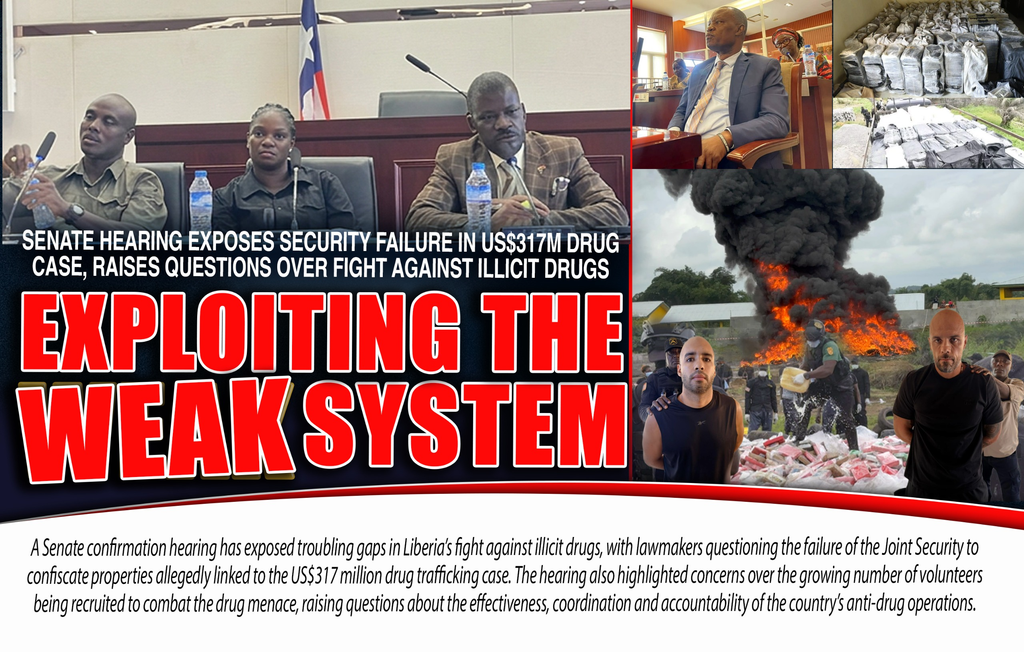
MONROVIA – The Senate chamber was quiet when Daniel Ziankhan was asked a question many Liberians have been asking for months: what happened to the property used to bring in more than US$317 million worth of cocaine? He did not answer it.
\n
By Obediah Johnson
\n
In the hours that followed on Monday, November 23, senators heard about an agency stretched thin, a workforce that is largely unpaid, a viral video that refuses to fade, and a law that has, so far, produced no confiscated assets. Taken together, the testimony from the second confirmation hearing for the Liberia Drug Enforcement Agency (LDEA) offered a rare look at the distance between what Liberia’s drug law promises and what its enforcers can deliver.
\n
The Promise of Section 14.97
\n
The law at the center of the day’s discussion is Liberia’s New Controlled Drugs and Substances Act, passed in 2023. Its Section 14.97 gives the government, through its security apparatus, the power to confiscate and forfeit properties tied to drug-related offenses, including trafficking.
\n
The provision reaches far. It covers money obtained from drug offenses, vehicles used to transport illegal drugs, and houses and building materials used in committing drug offenses. It extends to boats and other vessels used for trafficking, equipment and instruments used in drug crimes, and any other properties whose value corresponds to the proceeds of those offenses.
\n
In theory, the section strikes at what motivates traffickers: profit. Take the vehicles, boats and houses, and the business becomes costly. In practice, however, Liberia has been unable since 2023 to confiscate and sell drug-related properties or assets to serve as a deterrent to would-be traffickers.
Advertisement
That is the weakness the hearing exposed in the Joint Security Council (JSC), which is expected to enforce the law scrupulously, including in the US$317 million cocaine case and other illicit drug matters.
\n
A Careful Silence
\n
Ziankhan, the Director General-designate of the LDEA, is no stranger to the agency. He is currently its acting head, appointed recently by President Joseph Nyuma Boakai, who also named Precious Rue as Deputy Director-designate for Operations and Prince Mulbah as Deputy Director-designate for Administration.
\n
When lawmakers pressed him on the properties, Ziankhan pointed to the Ministry of Justice, which he said is responsible for implementing the law. As a member of the Joint Security, he said, he could not disclose whether the vehicles, boats and houses used in the US$317 million cocaine shipment had been confiscated and forfeited to the government.
\n
His reasoning was operational. Disclosure, he said, would compromise the ongoing work of the joint security and a case already before the courts. He also declined to say what the properties were worth, again saying the Ministry of Justice is better placed to do so.
\n
“The Ministry of Justice does that (confiscation and forfeiture of drug related properties). So, in the case as you may know Senator, it is active. I cannot come here to talk about that as to whether the properties were seized but people were indicted. Anything I say here, I will be compromising the operational security of what’s going on. So, I cannot say anything about it.”
\n
He suggested that decisions on confiscation and forfeiture may follow once the court cases are completed. That is a position with legal logic, since forfeiture usually depends on how cases are resolved. But it leaves a question hanging over the three years since the law took effect.
\n
The Problem of Ownership
\n
Ziankhan did offer one concrete detail. The agency, he said, currently holds vehicles that were arrested together with suspects and illicit substances. Moving those vehicles from custody to forfeiture, however, requires working through “technicalities.”
\n
The most important of these is a question of ownership. Authorities must establish whether the vehicles belong to the suspects or whether the suspects were merely passengers aboard them. A car seized with a drug courier inside is not necessarily the courier’s car, and a forfeiture that ignores that distinction could invite legal challenges.
\n
The explanation shows why asset forfeiture is harder than it sounds. It demands careful investigation, clear legal procedure and coordination among agencies, which are the very things that, by the testimony of the day, remain works in progress.
\n
An Army of Volunteers
\n
If the forfeiture question showed a gap in legal process, the discussion of staffing showed a gap in basic capacity. Ziankhan told senators that the LDEA has over 1,400 volunteers who have not been incorporated into the agency.
\n
These are people who serve as agents of the LDEA without any compensation from the government. Ziankhan described that arrangement as a serious security risk to Liberia, and his management team has begun trying to change it.
\n
The acting management has asked the more than 150 volunteers at the LDEA headquarters to “stand down and reapply.” The same approach, he said, will be extended to other sub-stations in Montserrado and other parts of the country, because the agency does not have the manpower to cover the entire nation.
\n
The reset is partial. Ziankhan noted that hundreds of other volunteers are still on assignment in the leeward parts of the country, despite the step being taken in Montserrado.
\n
Whether those volunteers eventually join the formal ranks, he said, will depend on money. Absorbing them onto the government payroll depends on the level of budgetary support the agency receives. He named training and the payment of attractive salaries as the measures needed to deal with the high level of volunteerism.
\n
He also described what he hopes to build. Ziankhan pledged an intelligence-driven, professionalized workforce at the LDEA, one that includes K9 dogs. He said the agency would share intelligence with partners and countries across the region to fight drug trafficking.
\n
The Video That Followed Her to the Senate
\n
Not all of the hearing’s tension came from policy. Precious Rue, the nominee for Deputy Director for Operations, again apologized to senators for a video that spread widely on social media.
\n
In the video, Rue was heard alleging that an unidentified individual had promised to make sure she received US$10,000 every week from a drug cartel for illegal trafficking of the substance in the country. A second issue arising from the video was her decision to ask another individual to go through her curriculum vitae before it was submitted to the Senate for confirmation.
\n
Rue told senators that she reported the matter involving the unnamed individual to heads at the agency before she was nominated. According to her, the report was made, and intelligence was gathered and shared with partners on the suspected individual.
\n
Asked whether she knew the person, she was direct. “Yes sir (I know the person); but I passed it over to the senior authorities. I was so much overjoyed and I over talked (on my graduation). This incident is regrettable. This is a learning curve for me and moving on, I will be overly careful.”
\n
On the CV, she was equally clear that asking someone to peruse the document was not meant to have it authored or falsified before it reached the Senate.
\n
For an agency whose credibility rests on the public’s trust that its officers cannot be bought, the episode carries weight. The words in the video, whatever the circumstances in which they were spoken, describe exactly the kind of offer the agency exists to resist. Rue’s account is that she did not accept it and instead passed it up the chain.
\n
A Badge Anyone Can Buy
\n
A different kind of credibility problem was raised by Prince Mulbah, the nominee for Deputy Director for Administration. He told senators there is a total lack of control over the use of uniforms designated for LDEA agents.
\n
Mulbah called on authorities of the Ministry of Justice to deal with the misuse and duplication of the uniform used by the LDEA and other state security bodies. Many volunteers and others, he said, continue to wear the uniform bearing the agency’s badge without having undergone proper training.
\n
He traced the problem to the growing number of private security firms and stores that produce and sell their own uniforms without being regulated by the ministry. “There are lot of (uniform) stores around our country anybody can lay hands on LDEA badge. Anybody can wear the uniform of police, PSU- even the private security firms-there is no regulation or control on what kind of uniform they should wear from national security. There are lot we need to do when it comes to reform.”
\n
The issue is not cosmetic. Mulbah said state security actors are unknowingly blamed for misconduct committed by officers from some private security firms. When a person in a lookalike uniform behaves badly, the public may not know the difference, and the agency whose badge was worn takes the blame.
\n
The problem also connects to the volunteer question. Volunteers wearing the uniform without proper training blur the line between a trained, accountable officer and someone who simply looks like one.
\n
A Senator’s Warning
\n
The most forceful remarks came from Grand Cape Mount County Senator Dabah Varpilah. She told the nominees that the strength or success of a law lies in the way it is implemented by those responsible for doing so.
\n
She encouraged them and other members of the joint security to implement the law scrupulously, without fear or favor, even as government budgetary support increases. “The LDEA and the entire security sector has to carry the drug law as your Bible or quoran, if you are a Muslim. The cartel or drug dealers are very strong because they control cash. I want to advice you, let’s take this as a responsibility for this country.”
\n
Senator Varpilah observed that Liberia’s future and stability would be guaranteed by how seriously the war against illicit drugs is taken. She said those leading the LDEA should ensure the drug laws are thoroughly implemented to the fullest, no matter who is involved or connected.
\n
She cautioned that poor implementation would come back to haunt the agency’s leaders if they failed to carry out their assigned tasks and responsibilities. Her view of the volunteer system was sharply negative. Varpilah described the increase in volunteers serving as agents at the LDEA as counter-productive to the fight against illicit drug trafficking and abuse in Liberia.
\n
Yet she did not stop at criticism. She asked LDEA authorities to submit a realistic work plan that would attract more budgetary allocation, so that the fight against drugs can benefit the country and its citizens.
\n
Cash Against the Law
\n
Her remark that cartels are strong because they control cash points to the logic behind Section 14.97. If traffickers draw their power from money and the assets it buys, then the law’s forfeiture powers are among the most direct tools available to weaken them.
\n
That makes the absence of seized and sold assets more consequential than a procedural delay. Each unused provision is an advantage left with the traffickers, and each month without a confiscation leaves intact the financial base that sustains the trade.
\n
The hearing also showed how the pieces connect. Forfeiture requires investigators with training, a legal process that establishes ownership, and prosecutors and courts that move cases forward. An agency that depends on unpaid volunteers and cannot control its own uniforms will find it difficult to carry out any of that reliably.
\n
The three nominees now await the Senate’s decision. Their testimony suggests they understand the scale of the task, even if some answers were deliberately withheld. Ziankhan has set out a plan built on training, better pay, intelligence-sharing, K9 units and a smaller, more professional force. Mulbah has put the uniform problem on the record and asked the Justice Ministry to act. Rue has apologized twice and said she will be more careful.
\n
What the Senate asked of them, in the end, was less about promises than proof. Senator Varpilah’s message was that the law is only as strong as the people who carry it out. Her challenge was to treat it with the seriousness of a sacred text.
\n
Whether the LDEA can meet that challenge depends partly on the nominees and partly on others: the Ministry of Justice, which Ziankhan says holds responsibility for forfeiture; the lawmakers who control the budget; and the courts where the biggest cocaine case is still being heard.
See more Liberia News Network stories in Google Search by adding LNN as one of your Preferred Sources.
★ Add LNN as a Preferred Source