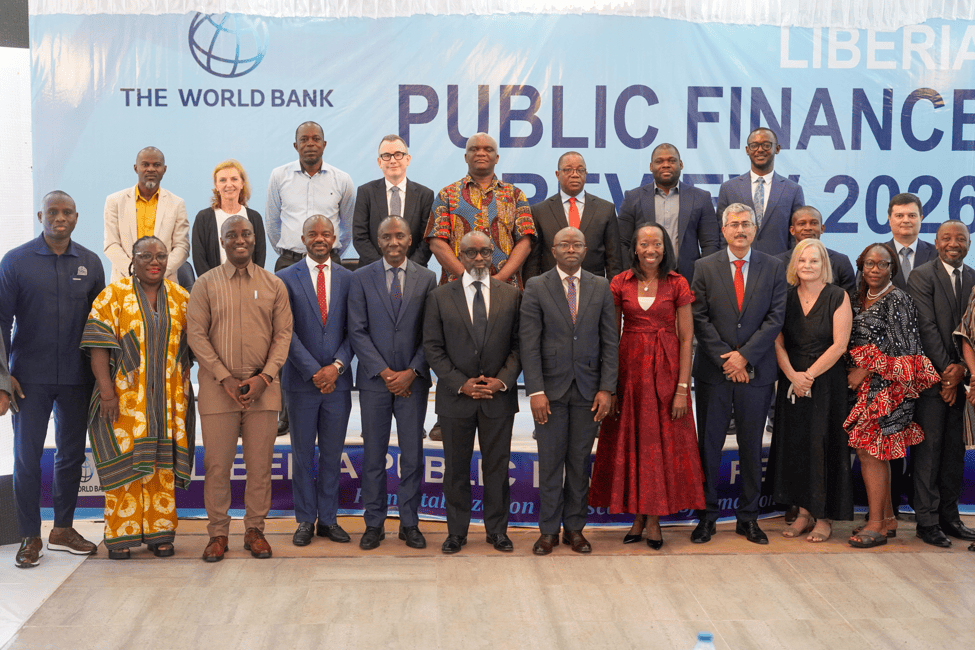
Monrovia – Liberia is leaving the equivalent of 5.3 percent of GDP on the table every year through weak tax compliance, inefficient spending and poor management of its mineral wealth, the World Bank warned Monday at the launch of the Liberia Public Finance Review 2026.
“The core message of the Public Finance Review is about opportunity,” said Georgia Wallen, World Bank Group Country Manager. According to her, It’s about Liberia’s opportunity to move to the next level: from fiscal stabilization to fiscal transformation.
Wallen praised the government for narrowing the fiscal deficit, reducing public debt and restoring growth, saying the achievements reflect proactive policy choices and sustained commitment.
But she warned the US$8.4 billion needed over five years for the ARREST Agenda for Inclusive Development cannot be met without unlocking domestic potential, asking “how can Liberia create greater and more durable fiscal space to finance these priorities?”
The report identifies a 3 percent of GDP tax gap and 5-6 percent of GDP in tax expenditures, arguing Liberia can mobilize far more “without relying primarily on higher statutory tax rates.”
“This is Liberia’s moment for fiscal transformation,” Wallen asserted, noting that VAT implementation, the Integrated Tax Administration System, and stronger governance of tax expenditures can provide an important foundation for sustained improvements in domestic revenue mobilization.
Presenting the findings, Muhammad Waheed, Senior Country Economist, said the public finance review comes at a very opportune time in Liberia’s fiscal journey, where as development assistance becomes more constrained.
“The central message is not simply that Liberia faces a financing gap. There is also substantial domestic potential to help bridge this gap,” Waheed said.
He said the deficit fell from 7.1% in 2023 to 2.1% in 2025 largely because of expenditure compression, including real-term wage cuts, rather than sustainable revenue growth.
On domestic revenue, Waheed stressed “we are not proposing… increasing the statutory tax rates,” pointing instead to compliance, risk-based audits and technology to close the 3-point gap.
On mining, he noted revenues jumped from $27 million in 2016 to $141 million in 2025, yet corporate income taxes barely contribute anything, with only $1.6 million collected in 2025 and 20% of gold production outside formal channels.
On spending, he warned, “mobilizing domestic revenue alone is not enough. We also need to improve the ability to convert budget allocation into actual investments,” citing 33% capital execution and efficiency scores of 58% for education and 67% for health.
He added that SOE liabilities of $800 million (17% of GDP) and climate risks could wipe out gains, warning “if you create fiscal space, but then these shocks consume whatever effort you have done, that will not yield us the development outcomes.”
Deputy Minister for Fiscal Affairs Anthony Myres said government interventions have restored stability, declaring “today, the confidence of the banking sector has returned,” after tackling non-performing loans and restoring predictable salary payments.
Myres said the government agrees with the diagnosis and will modernize the Revenue Code with 70 amendments, implement VAT in January, and enforce a new tax expenditure regime by 2027, noting “the report is correct, these are shortcomings and opportunities we have also identified, and we intend to work together.”
LRA Commissioner General James Dorbor Jallah promised tougher enforcement on under-declaration and integrated data systems, declaring “September is our month of the billions,” as domestic revenue nears $1 billion for the first time in 179 years.
See more Liberia News Network stories in Google Search by adding LNN as one of your Preferred Sources.
★ Add LNN as a Preferred Source