
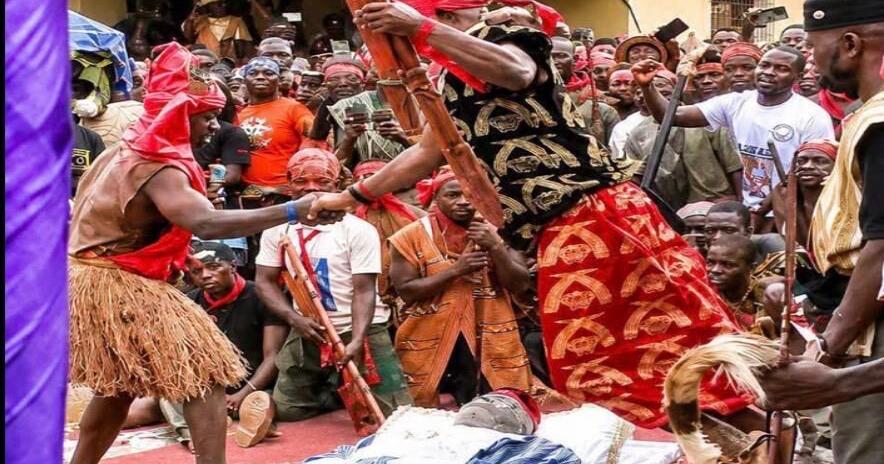
The long-running debate over who has inherited the political mantle of the late Senator Prince Y. Johnson has resurfaced after traditional leaders in Zor Zualay Township officially honored Senator Samuel G. Kogar as the “Godfather of Nimba.”
The declaration, made by elders and traditional authorities of Zor Zualay Township—home of the late General Thomas Quiwonkpa—has reignited political and cultural discussions over who now occupies the influential position once held by the late Senator Johnson, who died nearly two years ago.
According to traditional leaders in the township, Senator Kogar assumed the symbolic title after performing the traditional act of jumping over Senator Johnson’s body during his funeral rites. They contend that, under Dan (Gio) custom, the ritual signifies the transfer of the deceased’s title or status to the person performing it.
The announcement quickly generated widespread debate on social media.
Former Nimba County Representative Garrison D. Yealue supported the traditional leaders’ interpretation, arguing that the ritual carries deep cultural significance.
“In the Dan/Gio tradition, when a chief or warrior dies, the person who leaps over the body inherits the title of the deceased,” Yealue said. “This is not political maneuvering but a sacred cultural practice.”
His interpretation, however, was immediately challenged by Representative Nyan Flomo of Nimba County District #2.
Rep. Flomo argued that the ritual has strict traditional requirements and cannot be validated simply because someone jumped over a body during funeral ceremonies.
“Such rituals are traditionally performed in designated sacred places, especially in the case of a Zoe,” Flomo maintained. “If the proper traditional procedures are not followed, no legitimate claim to the title can be made.”
The controversy highlights the continuing struggle over the political legacy of the late Senator Johnson, who for decades was widely regarded as Nimba County’s undisputed political kingmaker.
Since Johnson’s death, Senator Kogar—his cousin—has increasingly presented himself as the county’s political successor. His position was strengthened after winning the Nimba County senatorial by-election to complete Johnson’s unexpired term through 2032.
But Kogar’s claim has not gone unchallenged.
Many political observers have viewed Vice President Jeremiah Kpan Koung as another heir to Johnson’s political influence. During the 2023 elections, the late senator publicly campaigned alongside Koung throughout Nimba County, repeatedly raising his hand before crowds as his preferred political successor.
That endorsement proved decisive. Koung and the Unity Party recorded an overwhelming victory across Nimba, a result widely credited to Johnson’s influence among voters.
Unlike Kogar, however, Koung did not perform the traditional funeral ritual that has become the center of the current debate.
Political analysts therefore distinguish between two different questions: cultural succession under traditional custom and political succession through electoral influence.
Kogar’s relationship with the late senator also adds another dimension to the discussion. Although the two were cousins and Johnson supported Kogar’s successful bid for the House of Representatives in 2011, the pair later experienced periods of political disagreement before eventually reconciling.
During Johnson’s funeral ceremonies in Bahn City, a predominantly Dan community, Kogar publicly jumped over the late senator’s body several times—a symbolic act that supporters say represented the transfer of traditional authority.
Traditional practitioners note that succession rituals vary depending on the status of the deceased. While rites involving a Zoe are generally conducted within a sacred shrine, those involving renowned warriors may be performed publicly, with ceremonial items such as weapons or other symbols of authority being passed to the successor. They also emphasize that only one person can perform the succession ritual, typically a close relative considered most qualified under tradition.
Despite the cultural arguments, Nimba’s political landscape appears less settled.
Although voters overwhelmingly elected Kogar to the Senate and many expected him to work closely with Vice President Koung, public debate continues over whether either man can truly claim the political influence once exercised by Prince Johnson.
For his part, Edwin Korden, Special Assistant to Vice President Koung and a native of Zor Chiefdom, has dismissed suggestions of any rivalry.
According to Korden, the Vice President has no interest in claiming the title of Nimba’s political godfather.
Meanwhile, Senator Kogar has turned attention to another issue involving the legacy of the late senator—the future leadership of the Movement for Democracy and Reconstruction (MDR).
Kogar recently called on the party’s leadership to convene a convention to elect a new standard bearer, arguing that the position should not remain vacant following Johnson’s death.
Before the 2023 general elections, the late Senator Johnson had overseen the election of Jeremiah Kpan Koung as MDR standard bearer. Koung later entered an alliance with the Unity Party and was elected Vice President of Liberia.
While traditional leaders may have bestowed the symbolic title of “Godfather of Nimba” on Senator Kogar, the broader political question of who truly commands Prince Johnson’s influence among Nimba voters remains far from settled.
