
MONROVIA – Liberia’s highest judicial officer has put the jury system on trial. Chief Justice Yamie Quiqui Gbeisay says jury tampering has contaminated verdicts and stalled the fight against corruption and drugs. He wants Liberians to abolish trial by jury through constitutional reform. The call lands on the Legislature, the Bar and the Law Reform Commission. It tests a right many citizens consider a democratic safeguard. Gbeisay paired the proposal with a stark disclosure. His family, he says, faces attacks over a Gompa City land judgment. His answer to tribal pressure was blunt: the courts recognize only justice. The October Term opens with reform on the docket and danger at the bench, as THE ANALYST reports.
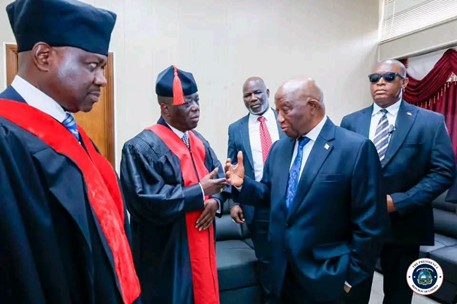
Chief Justice Yamie Quiqui Gbeisay, Sr., on Monday, October 12, 2026, called on the Liberian people to abolish the trial jury system, citing the egregious consequences of jury tampering for justice delivery and for the fight against corruption, drugs and other crimes.
Speaking at the opening of the October Term of the Supreme Court, the Chief Justice described jury tampering and what he called “the growing lack of the human face of the legal profession in Liberia” as matters that weigh most heavily upon the Court and the people it serves.
“We have seen cases delayed for years, mistrials declared, witnesses missing, verdicts questioned – not because the laws were unclear, but because the jury room was contaminated,” Gbeisay declared.
He stated that this has made the delivery of justice uncertain and, in some instances, impossible.
“The eradication of the trial jury system is not an abandonment of the people; it is instead a protection of the people,” the Chief Justice argued.
He insisted that where a peer judgment has become “peer manipulation, or peer crucifixion,” the Liberian people must act to preserve the integrity of the justice system.
Constitutional Reform Urged
Gbeisay noted that no country is an island and that other common law jurisdictions faced with similar challenges have made the transition. He urged Liberia to follow their experience “with courage and without sentimentality,” adding that “justice delayed, denied or distorted by corruption anywhere diminishes justice delivery everywhere.”
He invited the President, the Speaker and Members of the Legislature, the Senate Pro Tempore and Members of the Liberian Senate, the Liberian National Bar Association (LNBA), the Chairman of the Law Reform Commission (LRC) and all stakeholders of the justice system to join the Court in examining the question honestly.
The Chief Justice called on them to commission a constitutional reform that “will trigger an effective and efficient prosecution of crimes.”
Threats Over Gompa Judgment
Gbeisay disclosed that, up to and including the day of his address, his family remained under threat and subject to constant attacks. He stated that some individuals have vowed to kill him for allegedly giving their land to Mandingo people.
The disclosure came as the Chief Justice described the enforcement of court judgments, particularly in Montserrado and Nimba Counties, as another issue of grave concern to the Judiciary.
He noted that, as the courts endeavor to provide greater access to justice throughout the length and breadth of the country, the enforcement of court judgments remains a daunting challenge.
Recalling a 2018 incident, Gbeisay stated that some members of the Mandingo ethnic group in Gompa mobilized and violently obstructed the enforcement of a final judgment of the 8th Judicial Circuit Court against a member of their tribe.
He said the group’s spokesperson, one Mark Jabateh, took to the media and openly declared that he would kill Cllr. Francis Korkpor, then Chief Justice of the Supreme Court of Liberia, if he had laid his eyes on him.
“The past government took no action; instead, the present government rewarded him with a ministerial position in government,” the Chief Justice charged.
He told the gathering that two weeks ago the Magisterial Court in Gompa City, in an effort to enforce its final judgment, this time in favor of a Mandingo person, faced similar resistance from the Mano and Gio.
According to Gbeisay, the former Mayor of Gompa City, using tribal sentiment and claiming that Mandingo people have no land rights in Gompa City, successfully mobilized some members of the Mano and Gio communities against the court and specifically against the Chief Justice.
“I am the Chief Justice of Liberia, not the Chief Justice of any tribe,” he declared, adding that the judgments of the courts are based on evidence and the applicable laws, in keeping with the oath he took and continues to uphold.
‘Only Tribe Is JUSTICE’
“We cannot build this nation on ethnicity. The law is blind, and the only tribe recognized before a court of competent jurisdiction is JUSTICE,” Gbeisay stressed. He called on all Liberians, especially his fellow citizens in Gompa City, Nimba County, to unite irrespective of tribe or ethnic background.
The Chief Justice warned that tribalism destroys national unity and peace and further triggers violence and war. “Liberia has traveled down that road before, and we know where it led us. We must not go there again,” he cautioned.
He vowed that the Gbeisay Bench will enforce all legitimate judgments “without fear or favor and irrespective of its consequence.” “I have lived for justice, and I am prepared to die for justice,” the Chief Justice declared.
Backlog, Aged Cases Targeted
Gbeisay announced that during the October Term the Court will continue to focus on reducing case backlog, addressing aged and abandoned matters, improving case management, and ensuring the timely preparation and delivery of opinions. “Justice must be deliberate and careful, but justice must also be timely,” he noted.
He reminded members of the Bar that the efficient administration of justice is a shared responsibility of the Bench and Bar. The Chief Justice pointed to what he called the splendid performance of the Supreme Court during the March Term, 2026, as a demonstration of what can be accomplished when there is sustained commitment to judicial productivity and case management.
Accordingly, Gbeisay stated, the Supreme Court is determined to undertake a systematic review of aged cases on its docket and, consistent with applicable laws, Rules of Court and due process requirements, take appropriate action on matters that have been abandoned or not diligently pursued.
“A judicial docket cannot become a permanent repository for cases that the parties who initiated them have stopped pursuing,” he asserted.
The Chief Justice explained that the exercise is not intended to deprive anyone of the right to be heard. Rather, he said, it recognizes that a party who invokes a court’s jurisdiction assumes a corresponding responsibility to diligently pursue his or her case, and affected parties and their counsels will be afforded such notice and opportunity as the law and Rules of Court require.
Practice Rules Near Completion
Gbeisay reported substantial progress on the initiatives to improve, standardize and regulate the practice of law that the Court announced at the opening of the March Term, A.D. 2026. He noted that the Rules Governing the Practice of Law in Liberia had not been comprehensively reviewed for more than two decades.
Recognizing that several provisions required revision to respond to contemporary realities in the administration and practice of law, the Supreme Court constituted a committee of distinguished members of the legal profession to undertake a comprehensive review of the Rules.
The Chief Justice disclosed that the revised Rules have now been submitted to the Supreme Court, are presently under review, and shall be completed in a few weeks.
He stated that the Court is undertaking the review with the seriousness the subject deserves, as the Rules will regulate important aspects of the professional conduct, responsibilities and obligations of lawyers practicing throughout the Republic, with significant implications for the Bench, the Bar, litigants and the administration of justice generally.
According to Gbeisay, the objective is a modern regulatory framework that promotes professional competence, ethical conduct, accountability and respect for the courts, while preserving the essential role of lawyers as officers of the court and advocates for those whom they represent.
The Chief Justice also announced the completion of the law-firm registration exercise, under a policy announced in the March Term Opening Address requiring law firms practicing throughout the Republic to submit their registration and contact information to the Office of the Clerk of the Supreme Court.
He said the information collected is now being processed for publication as a booklet for circulation and use throughout the Judiciary.
Gbeisay explained that the initiative aims to establish a reliable institutional directory of recognized law firms and legal practitioners operating within the Republic.
The directory, he said, will assist the courts, particularly clerks, bailiffs and other ministerial officers, in locating lawyers and law firms for the proper and timely service of notices, precepts and other judicial processes, while improving communication within the legal profession and helping the Judiciary discourage the unauthorized practice of law.
He thanked the law firms and members of the Bar who cooperated with the exercise, quipping that “of course, they had no other alternative.”
The Chief Justice described the completion of the registration process as an important step toward greater organization, professionalism and accountability within the legal profession.
Standard Filing Format Coming
Another important reform, Gbeisay noted, concerns the standardization of applications and filings before the Supreme Court. He said the Court observed considerable differences in how applications and other filings were structured, including the presentation of jurisdictional grounds, issues for determination, statements of facts, legal arguments, authorities and the relief sought.
To address the concern, the Supreme Court constituted a committee headed by former Associate Justice Cllr. Pei Edwin Gausi to develop a standardized framework for filing papers before the Court.
The Chief Justice reported that the committee has submitted its second draft to the Office of the Chief Justice, as part of the continuing effort to develop clear and uniform requirements governing applications, briefs and other papers filed before the Supreme Court.
“This reform is not meant to impose unnecessary technical burdens on lawyers; rather, it will ensure that matters brought before the Court are presented clearly, concisely, professionally, legally and in line with international best practice,” Gbeisay stated.
He added that a properly structured filing enables the Court to readily identify its jurisdictional basis, the questions presented for determination, the relevant facts, the controlling legal authorities, the parties’ arguments and the precise relief sought.
According to the Chief Justice, standardization will benefit the Court, lawyers and litigants alike, and the appropriate format will be formally communicated to the Bar for guidance and compliance once the review and approval process is complete.
He described the three reforms – revising the Rules Governing the Practice of Law, registering law firms and standardizing filings before the Supreme Court – as part of the strengthening of the Bench and the Bar rather than isolated initiatives, noting that research has established that Liberia is the only country in the region with no established format for filing papers before its constitutional court.
Foreign Law Graduates Face Hurdles
Gbeisay reminded the gathering that the Supreme Court is mandated by Chapter 17 of the New Judiciary Law of Liberia and the current Constitution to regulate the practice of law in Liberia.
He noted that the enabling statute requires an applicant for admission to be a graduate of the Louis Arthur Grimes School of Law (LAGSL) or any recognized law school, which presupposes that the Supreme Court is the only legal authority to determine a recognized law school.
The Chief Justice explained that the LAGSL’s standing policy requires an applicant for admission to have obtained a first degree with a specified grade point average (GPA) and to have passed the aptitude test.
Having received scores of applications for admission to the Bar from graduates of institutions abroad, he said, the Supreme Court constituted a 12-man committee headed by a former professor of law, Cllr. Emmanuel James, to determine whether the applicants came from a “recognized law school” as contemplated by the statute.
Gbeisay disclosed that the committee submitted its report with appropriate recommendations to the full bench, finding that most of the applicants did not meet the minimum requirement of 90 credit hours, or three academic years of rigorous study, required in the jurisdiction.
He said the full bench analyzed the report and issued a policy guideline requiring the applicants to take additional specified courses at either of the two law schools to qualify them to be tested and subsequently admitted to practice law.
The effort, the Chief Justice argued, is intended to ensure the quality of law practice in the country, because inadequate knowledge of the law will result in poor administration of justice and eventually in poor governance.
He pledged that the Supreme Court will continue to work with the LNBA, the law schools, senior members of the profession and other stakeholders to ensure that legal practice develops in a manner consistent with the growing complexity of Liberia’s society, economy and system of justice.
“Beyond these institutional reforms, integrity must live in the daily conduct of counsels in every courtroom of this Republic,” Gbeisay declared. He stressed that the reforms being pursued within the Supreme Court must be accompanied by corresponding improvements throughout the Judiciary.
Strategic Plan, Monitoring Intensified
Turning to the state of the Judiciary in administration, accountability and reform, the Chief Justice said the Judiciary continued implementing the Judiciary Strategic Plan 2025–2029 during the period under review, with appropriate adjustments to address current institutional priorities.
He listed its focus as infrastructure development, digitization, court security, case management, financial accountability, professional training, public defense, improved court monitoring and greater access to judicial services.
Gbeisay stated that the objective remains to build a Judiciary that is independent, competent, accountable, accessible and capable of delivering justice efficiently throughout Liberia.
He reported that the Judiciary Monitoring, Evaluation and Accountability Department intensified monitoring of courts across the Republic, reaching numerous courts in several counties. The monitoring activities, he said, included physical verification of staff attendance, examination of court files, procedural compliance, assessment of court costs, fees and fines, and monitoring of case progression.
Tribute to Deceased Staff
The Chief Justice paid tribute to members of the Judiciary who passed away, naming Samukai Kromah, generator operator, Montserrado County; Landy Pinky Okai, office assistant, Montserrado County; Haja G. Paul, painter, Montserrado County; and Abednego W. Kray, security officer, Montserrado County. Also remembered were His Honor Octavius B. Doe, Probate Judge, Sinoe County; His Honor Kpah T. Gbarngbeh, Associate Magistrate, Sinoe County; Lee Munsiah, security officer, Nimba County; and Victor P. Tyeh, bailiff, Grand Kru County.
On behalf of his colleagues on the Supreme Court Bench and the entire Judiciary, Gbeisay extended deepest sympathy to their families and loved ones. “We remember and appreciate their service to the Judiciary and to the Republic,” he said, praying that their souls, and the souls of all those with sainted memories of the Judiciary, rest in perfect peace.
A Judiciary for Every Citizen
Closing his address, the Chief Justice told his colleagues and members of the Bar that the responsibility of the Bench in the new Term is not merely to preserve the Judiciary it inherited, but to improve it.
He said the Judiciary must remain a place where the citizen, irrespective of wealth, political influence, social standing, gender, ethnicity or place of residence, can come with confidence that the law will be applied fairly and impartially.
“The Judiciary cannot control every challenge confronting the justice system. But we can control the standards we set for ourselves,” Gbeisay concluded.
See more Liberia News Network stories in Google Search by adding LNN as one of your Preferred Sources.
★ Add LNN as a Preferred Source