Published: September 9, 2026
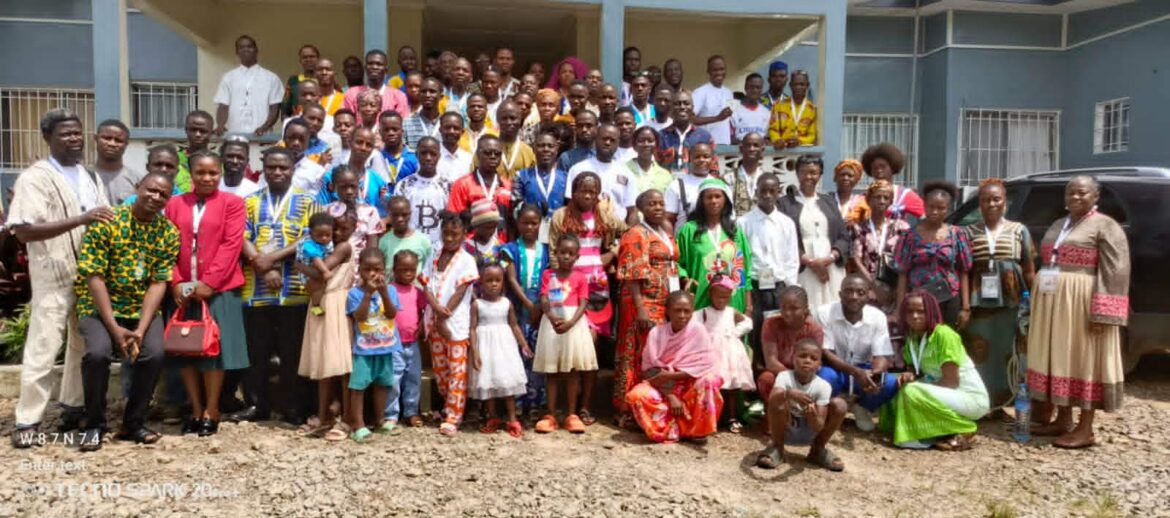
SANNIQUELLIE, Nimba County — From Thursday last week through Monday this week, Baha’is serving on institutions and agencies of the Baha’i Faith, alongside those actively engaged in community-building activities, gathered in Sanniquellie, Nimba County, for a period of reflection, consultation and collective learning on the current state and future direction of the Faith in Liberia.
The gathering, held under the theme “Embracing Large Numbers: The Community as a Protagonist,” formed part of Liberia’s response to a broader global process of assessing progress under the Baha’i Faith’s Nine-Year Plan, which has reached its midpoint.
Liberian representatives had earlier participated in a global conference in Abuja, Nigeria, in May, where Baha’is from different communities reflected on progress, challenges and emerging opportunities under the plan.
The Sanniquellie gathering sought to translate those global reflections into a Liberian context, with particular emphasis on moving communities from being passive recipients of activities to becoming active protagonists in a long-term process of spiritual and social transformation.
A member of the International Teaching Centre in Haifa, Israel, Mrs. Rachel Njeri Ndegwa, who also participated in the Abuja conference, joined the Liberian gathering and challenged Baha’is to widen their vision of community development and embrace everyone interested in contributing to the betterment of society.
Ndegwa said the Baha’i Faith has maintained a presence in Liberia for many years but suffered setbacks during the country’s civil wars, which disrupted communities and diminished the Faith’s visibility and activities.
“The Baha’i Faith has been in this country for many years but because of war, the Faith’s popularity went down,” she said. “Thanks to the friends here that the Baha’i Faith is back and we are continuing.”
She made the remarks at both the conference and the gathering with community members in Airfield Zone 2, Sanniquellie, Nimba County.
A Faith Built Around Unity
At the center of Ndegwa’s message was the central Baha’i teaching that humanity is one, God is one and religion is one.
She explained that being a Baha’i does not require rejecting other religions, but rather recognizing the common spiritual foundation underlying the world’s major faith traditions. “Our understanding from Baha’u’llah’s teachings is humanity is one, God is one and religion is one,” Ndegwa said.
She explained that Baha’is believe God periodically sends divine messengers to humanity to renew religious teachings in response to changing social and spiritual conditions.
“From time to time, God sends His Messengers and renews what has been said before because the realities of life change,” she said.
According to Ndegwa, each Manifestation of God brings teachings appropriate to the needs of the age, although people sometimes become attached to established religious interpretations and struggle to appreciate new teachings.
For Ndegwa, her own journey into the Baha’i Faith was shaped by a search for answers. “I became a Baha’i because I have a lot of problems. I ask a lot of questions. I found answers in the Baha’i Faith,” she said, adding, “The Baha’i Faith satisfied my quest.”
She said the teachings gave her a broader understanding of religious diversity and strengthened her conviction that people can coexist peacefully despite differences in belief. “I started respecting everyone who believes in whatever they believe in without judging them,” she said.
From Programs to Social Transformation
Ndegwa stressed that the Faith’s activities — including children’s classes, junior youth groups, devotional gatherings and study circles — should not be viewed simply as programs operated by Baha’is for Baha’is.
Rather, she said, the activities are instruments through which communities develop spiritual qualities, capacities and patterns of cooperation necessary for building a healthier society. Baha’is, she said, should seek to cultivate qualities such as love, peace, generosity, truthfulness, patience, trustworthiness and forbearance.
She cited Baha’u’llah’s teaching that human beings enter the world with a purpose to contribute to its betterment and live together in concord and harmony.
“What Baha’is are doing all over the world is to translate into reality what the Manifestation of God has written,” Ndegwa said.
She described the work as a multigenerational undertaking aimed at building societies that consciously pursue a collective purpose rather than focusing exclusively on individual interests.
“The collective purpose is the betterment of the world and living in concord and harmony,” she said.
Communities as Protagonists
The emphasis on the community as a protagonist represents a significant feature of the current Baha’i approach to growth. Ndegwa urged Baha’is to understand that they do not own the community-building programs.
“Baha’is do not own their programs. The communities own them,” she said, emphasizing that everyone should have an opportunity to participate and contribute.
She encouraged Baha’is to see people in their neighborhoods not as targets for conversion, but as friends, partners and fellow contributors to the development of their communities.
“Community dwellers, you are our friends, our family and our partners,” she said. “Let us continue to work together for the coming good of our communities.”
The approach, she said, requires Baha’is to demonstrate the teachings of their Faith through their lives and relationships. “As Baha’is, always prove that you are different not by the wrong reasons but living your lives in accordance with the teachings of the Faith,” Ndegwa said.
She also urged Baha’is to ensure that no one is excluded from the process. “Baha’is should lead the way in living exemplary lives. Leave no one behind,” she said.
Education at the Center
Ndegwa placed particular emphasis on the Baha’i Institute process, describing it as a systematic approach to developing individual and collective capacity.
She recalled that when the Universal House of Justice introduced the Institute process in 1996, emphasis was placed on Africa in particular and the rest of the world educating people, strengthening communities and addressing social practices that conflict with principles of human dignity and equality.
She said the process calls for the elimination of discrimination and harmful traditions, including discrimination based on sex, gender, race and religion.
The objective, she said, is not merely to increase the number of people formally identifying as Baha’is, but to allow the teachings to influence lives and contribute to social progress.
“The Baha’i Faith isn’t just yours. It belongs to everybody,” she said, urging participants to focus on the transformation of communities. “People becoming Baha’is should not be the only objective. Let the teachings of the Faith impart lives.”
She described the Baha’i endeavor as a spiritual enterprise rather than a nongovernmental organization, saying its broader purpose is to contribute to a transformation in thought and encourage collaboration in addressing social challenges.
Liberia’s Growing Community-Building Network
Jackson W. Gbelee, secretary of the National Spiritual Assembly of the Baha’is of Liberia, said the Sanniquellie gathering provided an opportunity for participants to reconsider how the activities of the Faith are being implemented.
He said the Baha’i system of community development is continuously refined as communities learn from their experiences. “Our system is always in a constant refinement. There are always new experiences and learnings,” Gbelee said.
He said Liberia’s Baha’i community has significant prospects for growth and has developed a structure covering different parts of the country.
According to Gbelee, Liberia has been divided into two broad regions — Central-West and South-East — with 72 clusters identified across the two regions. Activities are currently being pursued in 49 clusters, he said.
The cluster structure, however, remains subject to change as the community learns and adjusts its approach.
Gbelee said Liberia’s work is connected to global plans developed under the guidance of the Universal House of Justice, the Faith’s highest elected institution, based in Haifa, Israel.
He said Ndegwa’s presence in Liberia represents an important encouragement to efforts aimed at establishing intensive programs of growth across the country. The community-building activities, the NSA secretary said, are intended to promote learning, strengthen relationships and contribute to a more cohesive Liberian society.
Young People Taking Leadership
For Marie W. Dahn, a member of the National Spiritual Assembly, the gathering also represented an opportunity to reflect on the growing role of young people in the Faith.
Dahn said she was surprised when she was elected to the National Spiritual Assembly and had not imagined that she would be serving at the national level at such a stage of her life.
She traced her development through various levels of service, beginning with children’s classes and later working with junior youth groups.
“I grew through different levels: from teaching children’s classes to animating junior youth groups,” she said. Dahn said she now wants to encourage more young women to participate in Baha’i programs and use the opportunities to develop their capacities and contribute to society. She is also a member of the Local Spiritual Assembly of Ganta.
“The Baha’i Faith is a world religion which accommodates everybody,” Dahn said. “Come and join us. You have something to offer the world. We can make our world a better place together.”
Turning Reflection Into Action
Mehngoankeh Baymie, co-chairman of the National Spiritual Assembly, urged participants not to allow the lessons from the gathering to remain at the level of discussion.
“Let us take serious all these beautiful lessons and apply them,” Baymie said.
He said Baha’is should recognize the value of the teachings of Baha’u’llah in addressing both personal and broader societal concerns.
“We are blessed to have the teachings that have been brought to us by Baha’u’llah,” he said. “We have answers to our concerns and the concerns of the world.”
Cllr. Nana Out-Ansah similarly called for broader participation in the Institute process, urging Baha’is to strengthen the capacities of community members rather than concentrating responsibility among those formally serving on Baha’i institutions.
“Help your community to appreciate the Institute process,” Out-Ansah said. “Everybody should teach the Baha’i Faith, not only those who serve on the institutions and agencies of the Faith.”
Communities Welcome the Activities
The gathering also received encouragement from residents of Sanniquellie who have witnessed some of the Baha’i activities in their communities.
Morris Jones, a community member in Sanniquellie, expressed appreciation for the children’s classes, study circles and other activities organized by the Baha’is.
“Thank you to the Baha’is for the activities,” Jones said. “We welcome the children’s classes, the study circles and all other activities that promote our collective wellbeing.”
For the participants, the Sanniquellie gathering was therefore more than an internal conference. It was an opportunity to examine how a religious community can expand while maintaining a focus on service, education, unity and collective responsibility.
Ndegwa urged Baha’is to resist the temptation to see people as possessions or as numbers to be recruited. “People do not belong to you. They are not your goods or properties,” she said.
Instead, she encouraged participants to use the Baha’i writings and the Institute process to help communities discover the benefits of consultation, cooperation, peace and harmony.
She closed her engagement with a message of encouragement to those serving across Liberia, promising to pray for their efforts at the Baha’i holy places in Israel. “To all those involved with the activities, I will offer special prayers on your behalf at the shrines in the Holy Land in Israel,” she said. “Be assured that the Concourse on High will ensure your victory is achieved.”
As Liberia’s Baha’i community moves through the midpoint of the Nine-Year Plan, the Sanniquellie gathering underscored a central question facing the Faith: how to translate spiritual teachings into sustained community action while opening the process to ever-larger numbers of people.
For those gathered in Nimba County, the answer lies not simply in expanding membership, but in building communities in which children, young people, adults, elders and people of different religious backgrounds can learn, serve and work together toward what the Baha’i teachings describe as the betterment of the world.
See more Liberia News Network stories in Google Search by adding LNN as one of your Preferred Sources.
★ Add LNN as a Preferred Source